
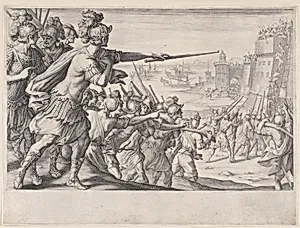
Prise de la Ville de Bone (Capture of the City of Bonne), from La Vie de Ferdinand Ier de Médicis série appelée aussi Les Batailles des Médicis (The Life of Ferdinand I de'Medici also called The Medici Battles)
Medium
Engraving; first state of two (Lieure)
Dimensions
Sheet: 9 x 12 in. (22.8 x 30.5 cm) Sheet: 8 7/8 x 11 7/8 in. (22.5 x 30.1 cm)
Classification
Prints
Department
Drawings and Prints
Museum
Metropolitan Museum of Art, New York, NY
Credit
Bequest of Edwin De T. Bechtel, 1957
Accession Number
57.650.363(12)
Rights
Public Domain
Art Historical Context
This engraving captures a dramatic moment from the military campaigns of Ferdinand I de’ Medici, Grand Duke of Tuscany. Created between 1614 and 1620 by Jacques Callot after designs by Matteo Rosselli, *Prise de la Ville de Bone* belongs to the series *The Medici Battles*, which celebrates Ferdinand’s victories against Ottoman and Barbary forces in North Africa. The print depicts the 1607 capture of the fortified port of Bône (modern Annaba, Algeria), an event that underscored Tuscan naval power and the Medici family’s role in Mediterranean politics. Callot’s precise engraving technique brings remarkable clarity to the crowded scene of soldiers, ships, and fortifications. As the first of two states, this impression reveals the artist’s meticulous line work and ability to convey both the chaos of battle and the grandeur of victory within a compact format. Such prints were widely circulated, helping spread the Medici’s political message across Europe while showcasing Callot’s emerging reputation as one of the finest printmakers of the seventeenth century. Today in the Metropolitan Museum’s collection, the work offers viewers a vivid window into early Baroque court propaganda and the technical brilliance of early modern printmaking.
About the Artist
Jacques Callot|Matteo Rosselli · 1592–1635
Jacques Callot (1592–1635) was a French printmaker and draftsman from the Duchy of Lorraine, widely regarded as one of the first great artists to practice the graphic arts exclusively. His more than 1,400 etchings chronicled the breadth of 17th-century life, from Medici court festivities to the brutal realities of warfare. Callot revolutionized etching through technical innovations including the é...