
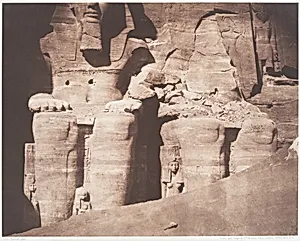
Abo-Sembil, Grand Spéos, Statues Colossales vues de Face (Parte Inférieure)
1851–52
Medium
Salted paper print from paper negative
Dimensions
Image: 24.3 x 30.8 cm (9 9/16 x 12 1/8 in.) Mount: 37.9 x 50.1 cm (14 15/16 x 19 3/4 in.)
Classification
Photographs
Department
Photographs
Museum
Metropolitan Museum of Art, New York, NY
Credit
Gilman Collection, Purchase, The Horace W. Goldsmith Foundation Gift, through Joyce and Robert Menschel, 2005
Accession Number
2005.100.60
Rights
Public Domain
Tags
Art Historical Context
Step into the shadow of ancient giants with Félix Teynard's *Abo-Sembil, Spéos, Statues Colossales vues de FaceParte Inférieure)*, a salted paper print from a paper created during his 1851–52 expedition Egypt. This 24.3 x 30.8 cm image captures the towering lower portions of the colossal statues guarding the entrance to Abu Simbel's Great Temple, a rock-cut marvel built by Pharaoh Ramses II in the 13th century BCE. Tnard, a French architect-photographer, was part of the mid-19th-century wave of Europeans documenting Egypt's monuments, blending scientific precision with artistic vision. The salted paper process, a calotype technique pioneered by William Henry Fox Talbot, used a paper negative to produce richly toned, detailed positives—revolutionary for its ability to yield multiple prints from a single exposure. At a time when travel to remote Nile sites was arduous, Teynard's photograph brought the immense scale and weathered grandeur of these 20-meter-tall figures to European audiences, fueling Egyptomania and scholarly study. Housed in the Metropolitan Museum of Art's Gilman Collection, it exemplifies early photography's power to preserve architecture and sculpture, bridging antiquity and modernity. (198 words)
About the Artist
Félix Teynard · 1817–1892
**Félix Teynard (1817–1892)** was a pioneering French photographer whose work captured the ancient wonders of Egypt and Nubia with unprecedented precision and artistry. Born on January 14, 1817, in Saint-Flour, he trained as a civil engineer in Grenoble, a hub of Egyptology that likely sparked his fascination with ancient architecture. Little is documented about his early life or formal photograph...