
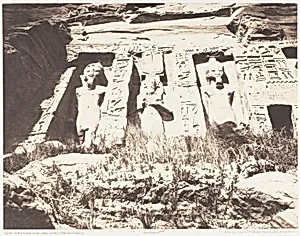
Abou-Sembil, Petit Spéos - Partie Gauche de la Façade
1851–52, printed 1853–54
Medium
Salted paper print from paper negative
Dimensions
23.3 x 30.5 cm. (9 3/16 x 12 in.)
Classification
Photographs
Department
Photographs
Museum
Metropolitan Museum of Art, New York, NY
Credit
Purchase, Lila Acheson Wallace Gift, 1976
Accession Number
1976.607.104
Rights
Public Domain
Tags
Art Historical Context
Step into the sun-baked sands of ancient Nubia with Félix Teynard's *Abou-Sembil, Petit Spéos -ie Gauche de laçade* (1851–52, printed 1853–), a salted paper print capturing the majestic left facade of the Smaller Temple at Abu Simbel Commissioned through the Imprimerie Photographique de. de Fonteny et, this 23.3 x 30.5 cm photograph freezes the colossal rock-cut sculptures of Queen Nefertari and goddesses, guardians of the temple built by Ramses II around 1264–1244 BCE to honor his beloved wife and Hathor. Teynard, a pioneering French photographer, joined the wave of 19th-century explorers documenting Egypt's wonders amid Europe's Egyptomania, sparked by Napoleon's earlier campaigns. His image, part of the landmark album *Œuvre de photographie d'Égypte et de Nubie*, offered unprecedented precision—far surpassing hand-drawn sketches—preserving intricate hieroglyphs and architectural details for scholars and the public. Crafted via the calotype process (salted paper print from a paper negative), this early technique yields a soft, textured glow that evokes the site's timeless mystery. Acquired by The Metropolitan Museum of Art in 1976 through the Lila Acheson Wallace Gift, it stands as a bridge between antiquity and modernity, inviting us to marvel at human ambition carved in stone.
About the Artist
Félix Teynard|Imprimerie Photographique de H. de Fonteny et Cie · 1817–1892
**Félix Teynard (1817–1892)** was a pioneering French photographer whose work captured the ancient wonders of Egypt and Nubia with unprecedented precision and artistry. Born on January 14, 1817, in Saint-Flour, he trained as a civil engineer in Grenoble, a hub of Egyptology that likely sparked his fascination with ancient architecture. Little is documented about his early life or formal photograph...