
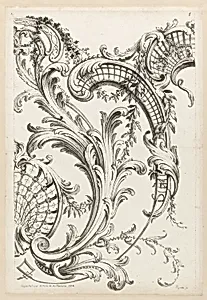
Acanthus Leaf and Fretwork Ornament Design
Classification
Department
Smithsonian Collection
Museum
Smithsonian American Art Museum
Credit
Purchased for the Museum by the Advisory Council
Accession Number
1921-6-213-5
Rights
Public Domain
About this artwork
Research in Progress
Art Historical Context
Created by French designer Alexis Peyrotte between 1749 and 1761, this ornamental print showcases the elegant vocabulary of Rococo decoration at its height. Peyrotte, active during the reign of Louis XV, specialized in furnishing patterns that blended natural forms with delicate geometry. The acanthus leaf—long a symbol of classical endurance—curls alongside precise fretwork, demonstrating the period’s taste for graceful asymmetry and refined detail. As a print, the work served a practical purpose: it circulated among artisans, cabinetmakers, and textile designers who adapted its motifs for furniture, wall panels, and silks. Such designs helped spread French taste across Europe and the American colonies, influencing everything from Philadelphia high chests to London drawing rooms. Though the exact printing technique remains under study, the sheet’s crisp lines reveal Peyrotte’s skill at translating three-dimensional ornament onto paper. Today the design offers visitors a window into how 18th-century artists turned nature and mathematics into harmonious pattern, reminding us that beauty in the Rococo era was meant to be both seen and used.