
Actor Nakamura Senya as Tokonatsu in the Kabuki Play, "The Legacy of the Three-Comma Family Crest Revealed" (Mitsutomoe Katoku Binaki)
ca. 1716
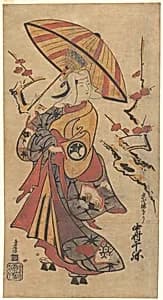
Medium
Woodblock print (tan-e); ink and color on paper
Dimensions
23 1/4 x 12 1/4 in. (59.1 x 31.1 cm)
Classification
Prints
Culture & Period
Japan · Edo period (1615–1868)
Department
Asian Art
Museum
Metropolitan Museum of Art, New York, NY
Credit
Harris Brisbane Dick Fund and Rogers Fund, 1949
Accession Number
JP3100
Rights
Public Domain
Tags
Art Historical Context
Step into the vibrant world of Edo-period Japan with this striking woodblock print by Torii Kiyomasu I, a master of the Torii school around 1716. Titled *Actor Nakamura Senya as Tokonatsu in the Kabuki Play, "The Legacy of the Three-Comma Family Crest Revealed" (Mitsutomoe Katoku Binaki)*, it captures the dynamic pose of Kabuki star Nakamura Senya in his role as the character Tokonatsu. Framed by trees, the image evokes the theatrical drama of the stage, blending natural elements with performative energy in a narrow hosoban format (23 1/4 x 12 1/4 in.). This tan-e print—meaning "red picture"—exemplifies early color woodblock techniques, using ink and subtle pigments on paper to achieve bold contrasts and expressive lines. Kiyomasu I pioneered yakusha-e (actor prints), popularizing ukiyo-e's "floating world" aesthetic that celebrated fleeting pleasures like theater. The Torii school's bold outlines and vivid hues made these affordable prints a sensation among urban audiences in 18th-century Tokyo. Culturally, Kabuki was Japan's premier entertainment during the Edo period (1615–1868), with actors like Senya idolized as celebrities. This artwork not only documents a specific performance but also preserves the glamour of onnagata (male actors playing female roles) and the play's intrigue around family legacies. Housed in the Metropolitan Museum of Art, it offers a window into how art democratized theater for the masses.
About the Artist
Torii Kiyomasu I · 1696–1716
Torii Kiyomasu I was a Japanese ukiyo-e artist working in the early eighteenth century, closely associated with the Torii school, one of the most important lineages in the history of Japanese woodblock printmaking. The Torii school was founded by Torii Kiyonobu, and Kiyomasu I is believed to have been either his son or a close pupil — the precise family relationship remains a matter of scholarly d...