
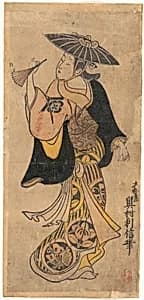
Actor Sanjo Kantaro (1697–1763) as a Woman
ca. 1730
Medium
Woodblock print (urushi-e); ink and color on paper
Dimensions
H. 12 3/8 in. (31.4 cm); W. 5 3/4 in. (14.6 cm)
Classification
Prints
Culture & Period
Japan · Edo period (1615–1868)
Department
Asian Art
Museum
Metropolitan Museum of Art, New York, NY
Credit
H. O. Havemeyer Collection, Bequest of Mrs. H. O. Havemeyer, 1929
Accession Number
JP1607
Rights
Public Domain
Tags
Art Historical Context
This vibrant woodblock print, titledActor Sanjo Kantaro1697–1763) as a Woman*, was created around 1730 by Okumura Toshinobu, a Japanese artist of the Edo period (1615–1868). Toshinobu captures the kabuki star Sanjo Kantaro I in the graceful guise of an onnagata male actor specializing in female roles, a hallmark of kabuki theater's all-male tradition. Adorned with an elaborate hat and fan, Kantaro's poised figure exudes elegance, reflecting the "floating world" (ukiyo) culture of urban pleasure and performance in 18th-century Japan. Printed in the innovative urushi-e technique—using glue (urushi) mixed with pigments for glossy, hand-applied colors on paper—this narrow, vertical format (about 12⅜ × 5¾ inches) suggests it was designed for intimate viewing, perhaps as an album leaf or fan insert. Urushi-e marked an early leap in color woodblock printing, bridging hand-coloring and multi-block methods that would define ukiyo-e's golden age. Housed in the Metropolitan Museum of Art's Asian Art Department from the H. O. Havemeyer Collection, this print offers a window into Edo Japan's theatrical fervor, where stars like Kantaro blurred gender lines to mesmerize audiences, blending artistry, celebrity, and social commentary in one shimmering image.
About the Artist
Okumura Toshinobu · 1690–1770
active ca. 1717–1750