
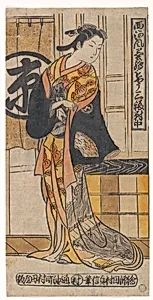
Actor Tsu-uchi Monsaburo in a Woman's Role in the Play "Three Instances of Good Fortune (Sanpuku Tsui)"
ca. 1730
Medium
Woodblock print (urushi-e)
Dimensions
H. 12 1/16 in. (30.6 cm); W. 6 in. (15.2 cm)
Classification
Prints
Culture & Period
Japan · Edo period (1615–1868)
Department
Asian Art
Museum
Metropolitan Museum of Art, New York, NY
Credit
Rogers Fund, 1922
Accession Number
JP1309
Rights
Public Domain
Tags
Art Historical Context
In the bustling theater districts of 18th-century Edo (modern Tokyo), woodblock prints like this one the allure of kabuki, immortalizing their dramatic personas. Titled *Actor Tsu-uchiaburo in a Woman's in the Play "Three of Good Fortune (Sanuku Tsui)"*, ca. 1730 urushi-e print by Tamura Sadanobu portrays the celebrated actor Tsuuchi Monsaburo as a female character. Sadanobu, an early ukiyo-e, specialized in yakusha-e (actor prints), blending sharp lines and expressive poses to convey the performer's charisma and emotional depth. The urushi-e technique—using lacquer-like glue for vibrant, glossy colors—was a pioneering method in Japanese printmaking during the Edo period (1615–1868). This small-format print (about 12 x 6 inches) was affordable and popular among urban fans, reflecting kabuki's cultural dominance. Male actors like Monsaburo excelled in onnagata roles, masterfully embodying women with stylized gestures and costumes, a tradition born from historical bans on female performers. Housed in the Metropolitan Museum of Art's Asian Art Department (Rogers Fund, 1922), this piece offers a window into Japan's floating world of entertainment, where art and theater intertwined to celebrate fleeting beauty and star power.