
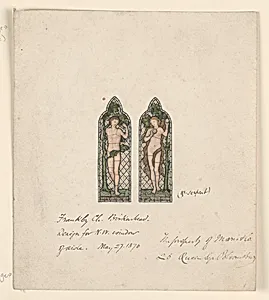
Adam and Eve, Design for Stained Glass Window, Frankby Church, Birkenhead (Cheshire), England
May 27, 1870
Classification
architecture, interiors
Department
Smithsonian Collection
Museum
Smithsonian American Art Museum
Credit
Museum purchase in memory of Mrs. Charles B. Alexander
Accession Number
1946-71-1
Rights
Public Domain
About this artwork
Research in Progress
Art Historical Context
Sir Edward Burne-Jones, prominent English artist of the Pre-Raphael Brotherhood and Arts and Crafts movement (1833–1898), created this preparatory design for a stained glass window on May 27, 1870. Titled *Adam and Eve*, it intended for Frankby Church inkenhead, Cheshire, England, capturing the biblical scene with the artist's signature ethereal figures and lush, medieval-inspired details. Burne-Jones was renowned for his collaborations with William Morris's firm, producing hundreds of such designs that revived Gothic stained glass traditions during the Victorian era's Gothic Revival. Stained glass designs like this one served as detailed blueprints—often full-scale cartoons—guiding artisans in assembling vibrant glass panels with leading and pot-metal colors. Burne-Jones's Pre-Raphaelite style emphasized symbolic narratives, intricate patterns, and a dreamlike beauty, infusing sacred spaces with spiritual depth. This window would have bathed the church interior in jewel-toned light, evoking paradise lost. Acquired by the Smithsonian American Art Museum through purchase in memory of Mrs. Charles B. Alexander, the work highlights transatlantic appreciation for British design. Though research continues, it exemplifies Burne-Jones's enduring influence on decorative arts, bridging fine art and architecture for worshippers and visitors alike.