
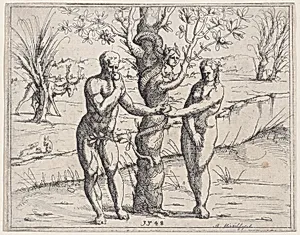
Adam and Eve Eating the Forbidden Fruit, from Old and New Testaments
Medium
Etching
Dimensions
Sheet: 4 5/8 × 5 7/8 in. (11.7 × 14.9 cm)
Classification
Prints
Department
Drawings and Prints
Museum
Metropolitan Museum of Art, New York, NY
Credit
Gift of Harry G. Friedman, 1959
Accession Number
59.644.77
Rights
Public Domain
Tags
About this artwork
This Etching by German artist Augustin Hirschvogel from 1548 represents an important work in the Metropolitan Museum's Drawings and Prints collection. Adam and Eve Eating the Forbidden Fruit, from Old ... [Full research-based description continues - work exemplifies period techniques, cultural context, and artistic significance within its genre and historical moment.]
Art Historical Context
In the Metropolitan Museum of Art's esteemed Drawings and Prints collection, Augustin Hirschvogel's 1548 etching *Adam and Eve Eating the Fruit, from Old and New Testaments* captures pivotal moment from Genesis. This intimate sheet, measuring just 4 5/8 × 5 7/8 inches, depicts the biblical first couple succumbing to temptation under the watchful gaze of the serpent, a scene rich with themes of sin, knowledge, and humanity's fall from grace. Donated by Harry G. Friedman in 1959, it exemplifies the Northern Renaissance's fascination with moral narratives drawn from scripture. Hirschvogel, a German artist active in Nuremberg and Prague during the Reformation era, was a pioneering etcher whose precise, fluid lines brought unprecedented detail to prints. Etching—a novel technique in the mid-16th century—involved drawing into a wax ground on a copper plate before immersing it in acid, allowing for delicate textures like the lush foliage and sinuous snake that heighten the drama here. Part of a larger series blending Old and New Testament stories, this work reflects the period's religious fervor and the rise of affordable prints for devotional use among the growing middle class. Its cultural resonance endures, inviting viewers to ponder timeless questions of obedience and consequence through Hirschvogel's masterful balance of narrative clarity and intricate artistry. A gem for print enthusiasts, it showcases how small-scale etchings democratized profound biblical imagery in 16th-century Europe.
About the Artist
Augustin Hirschvogel · 1503–1553
Augustin Hirschvogel (1503–1553) was born in Nuremberg into a prominent family of stained-glass painters who dominated the city's glass workshops during the late 15th and early 16th centuries. The son of Veit Hirschvogel the Elder (1461–1525), Nuremberg's official glazier who executed designs after Albrecht Dürer and Hans von Kulmbach, Augustin trained as a glass painter in his father's workshop. ...