
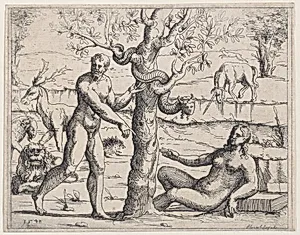
Adam and Eve Eating the Forbidden Fruit, from Old and New Testaments
Medium
Etching
Dimensions
Sheet: 4 5/8 × 5 7/8 in. (11.7 × 14.9 cm)
Classification
Prints
Department
Drawings and Prints
Museum
Metropolitan Museum of Art, New York, NY
Credit
Gift of Harry G. Friedman, 1959
Accession Number
59.644.78
Rights
Public Domain
Tags
Art Historical Context
In the heart of the Northern Renaissance, German artist and printmaker Augustin Hirschvogel crafted *Adam and Eve Eating the Fruit* in 1548 as part of his series *Old and Newaments*. This intimate etching captures the pivotal biblical moment from Genesis, where Adam and Eve succumb to temptation amid the lush Garden of Eden. Surrounding them are symbolic creatures—lions, unicorns, deer, and serpents—evoking a prelapsarian paradise filled with harmony and wonder, a common motif in Renaissance depictions of the Fall. Hirschvogel, a Nuremberg native renowned for pioneering etching techniques in Germany, masterfully used the medium's acid-bitten lines to achieve delicate textures and atmospheric depth on a modest sheet of just 4 5/8 × 5 7/8 inches. Etching allowed for intricate details unattainable in earlier woodcuts, making prints like this accessible to a wider audience during the Reformation era, when religious imagery proliferated. Housed in the Metropolitan Museum of Art's Drawings and Prints department (gift of Harry G. Friedman, 1959), this work exemplifies Hirschvogel's blend of spiritual narrative and naturalistic observation, reflecting 16th-century fascination with both faith and the natural world. It's a poignant reminder of humanity's origins, inviting visitors to ponder themes of innocence and consequence.
About the Artist
Augustin Hirschvogel · 1503–1553
Augustin Hirschvogel (1503–1553) was born in Nuremberg into a prominent family of stained-glass painters who dominated the city's glass workshops during the late 15th and early 16th centuries. The son of Veit Hirschvogel the Elder (1461–1525), Nuremberg's official glazier who executed designs after Albrecht Dürer and Hans von Kulmbach, Augustin trained as a glass painter in his father's workshop. ...