
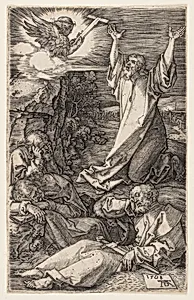
Agony in the Garden, from The Engraved Passion
Classification
religion
Department
Smithsonian Collection
Museum
Smithsonian American Art Museum
Credit
Smithsonian American Art Museum
Accession Number
1951-82-3
Rights
Public Domain
About this artwork
Research in Progress
Art Historical Context
Albrecht Dürer's *Agony in the Garden created in 1508, is a poignant engraving from his renowned series *The Engraved*. This Northern Renaissance master, born in Nuremberg in 1471, captured the biblical moment when Jesus prays in the Garden of Gethsemane, betrayal and impending crucifixion. Dürer's work reflects the intense spirituality of early 16th-century Germany, blending devout faith with humanistic detail during the eve of the Protestant Reformation. As part of a suite of 37 copper engravings, this piece showcases Dürer's revolutionary printmaking technique. His precise, intricate line work allowed for extraordinary depth, texture, and emotional drama—hallmarks of his style that made fine art accessible beyond elite patrons through affordable reproductions. The composition likely emphasizes Christ's solitude and anguish, surrounded by sleeping disciples, inviting viewers to contemplate human vulnerability and divine suffering. Housed in the Smithsonian American Art Museum's collection, *Agony in the Garden* exemplifies Dürer's enduring influence on religious art. His engravings not only elevated the medium to high art but also spread Renaissance ideals across Europe, bridging Gothic traditions with emerging naturalism. A timeless meditation on sacrifice, it continues to resonate with visitors seeking solace in shared spiritual narratives.