
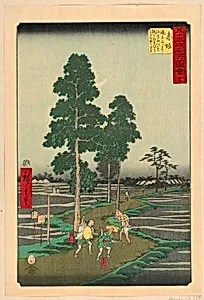
Akasaka: On the Nawate Road, Yajirobei Takes Kitahachi for a Fox and Beats Him (Akasaka, Nawatemichi ni te Yajirobei Kitahachi o kitsune to omohite chochaku suru) from the Series 53 Stations of the Tokaido
1797-1858
Medium
landscapes
Classification
landscapes
Department
Smithsonian Collection
Museum
Smithsonian American Art Museum
Credit
Gift of the Estate of Mrs. Robert H. Patterson
Accession Number
1941-31-232
Rights
Public Domain
About this artwork
Research in Progress
Art Historical Context
In the vibrant world of 19th-century Japanese ukiyo-e prints, Ando Hiroshige (1797–1858) stands as a master of landscape artistry. This woodblock print, *Akasaka: On the Nawate Road, Yirobei Takes Kitah for a Fox and Beats*, hails from his renowned series *53 Stations of the Tōkaidō* (ca. 1833–1834). The Tōkaidō was the historic coastal road connecting Edo (modern Tokyo) to Kyoto, dotted with 53 post stations where travelers rested. Hiroshige's series captured these stops with poetic beauty, blending natural scenery, human activity, and fleeting moments of life, making art accessible to everyday people through affordable color prints. Here, at Akasaka station, Hiroshige infuses the landscape with humor and drama. The title draws from a popular folktale or kabuki story where the bumbling Yajirobei mistakes his companion Kitahachi for a shape-shifting fox—a mischievous spirit in Japanese lore—and gives him a thrashing along the Nawate Road. Towering pines and misty hills frame the chaotic scene, showcasing Hiroshige's signature techniques: bold outlines, subtle gradations of color (via intricate woodblock printing), and atmospheric perspective that evokes travel's unpredictability. Hiroshige's work bridged Eastern and Western art, inspiring Impressionists like Van Gogh. Donated to the Smithsonian American Art Museum as a gift from the Estate of Mrs. Robert H. Patterson, this print celebrates Japan's Edo-period culture, where journeys were as much about stories and spirits as stunning vistas. A delightful glimpse into a bygone era!