
Alexander Hamilton Stephens
Medium
Classification
Department
Smithsonian Collection
Museum
Smithsonian American Art Museum
Credit
National Portrait Gallery, Smithsonian Institution
Accession Number
NPG.84.105
Rights
Public Domain
Tags
About this artwork
Born near Crawfordville, Georgia
Art Historical Context
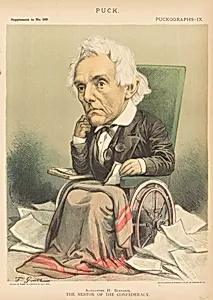
This evocative 1882 print by Frederich Graetz a German-American illustrator known for his work in satirical magazines like *Puck*, captures Alexander Hamilton Stephens the Confederate Vice President during the Civil War. Titled *Alexander Hamilton Stephens*, the portrait depicts the Georgia native—born near Crawfordville—in his later years, seated in a wheelchair with a blanket draped over his lap, pince glasses perched on his nose, and a in hand. Graetz precise line work and attention to personal details humanize a polarizing figure, blending portraiture with subtle caricature typical of 19th-century printmaking. Stephens, a lawyer and newspaper publisher, rose to prominence as a U.S. Congressman before becoming the Confederacy's vice president, where he delivered the infamous "Cornerstone Speech" defending slavery as its foundation. Post-war, despite health struggles that confined him to a wheelchair, he returned to Congress, embodying the turbulent Reconstruction era. This print, produced just a year before his death in 1883, reflects the era's fascination with Civil War leaders amid national reconciliation efforts. As a chromolithographic print from the Smithsonian American Art Museum's collection (housed in the National Portrait Gallery), the work highlights the medium's role in democratizing imagery—affordable reproductions brought historical figures into homes and newspapers, shaping public memory of the divided American past. A poignant window into 19th-century politics and portraiture.