
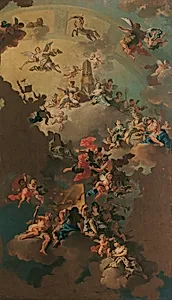
Allegorie auf die glückliche Regierung Mährens
um 1734
Medium
Öl auf Leinwand
Dimensions
125 x 74 cm
Classification
Gemälde
Department
Belvedere Collection
Museum
Belvedere
Credit
Belvedere, Vienna
Accession Number
4240
Rights
Public Domain
About this artwork
Wohl Anfang 1734 erhielt Daniel Gran den Auftrag, den Landtagssaal des alten Ständischen Landhauses in Brünn (Brno), das heute als Rathaus fungiert, mit einem Deckenfresko zu schmücken. Außer der vorliegenden Ölskizze, die in Teilen unvollendet ist, existiert eine zweite im Bestand der Gemäldegalerie der Akademie der bildenden Künste in Wien. Diese ist im Ausführungsgrad weiter fortgeschritten und weist unten zusätzliche Figuren auf.
Art Historical Context
Daniel Gran's *Allegorie auf die glückliche Regierung Mährens* (Allegory of the Happy Government of Moravia), an oil sketch on canvas from around 1734, offers a fascinating glimpse into the creative process of one of Austria's leading Baroque painters. Measuring 125 x 74 cm, this partially unfinished preparatory work was commissioned in early 1734 to design a grand ceiling fresco for the Diet Hall of the old Estates' Landhaus in Brünn (now Brno, Czech Republic), which serves today as the city's town hall. Gran, known for his dynamic frescoes blending illusionistic architecture with allegorical figures, captured the prosperity and harmony of Moravian governance under Habsburg rule—a common theme in 18th-century celebratory art. As a *bozzetto* (oil sketch), it allowed Gran to experiment with composition and color before executing the monumental fresco. Its incomplete state reveals the artist's iterative technique, with bold brushstrokes sketching ethereal figures symbolizing abundance, justice, and stability. A more advanced counterpart exists in the Picture Gallery of the Academy of Fine Arts in Vienna, featuring additional figures at the base, highlighting Gran's refinements for dramatic ceiling perspective. Housed in Vienna's Belvedere Collection, this sketch not only showcases Gran's mastery of Baroque allegory but also underscores the cultural role of art in affirming regional pride and political legitimacy during the Enlightenment era. A true gem for understanding fresco planning!