
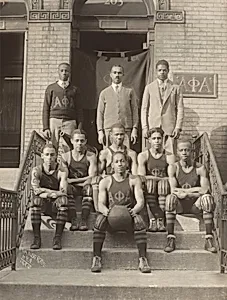
Alpha Phi Alpha Basketball Team
Medium
gelatin silver print
Dimensions
image/sheet: 23.34 × 17.94 cm (9 3/16 × 7 1/16 in.)
Classification
Photograph
Department
CPH
Museum
National Gallery of Art, Washington, D.C.
Credit
Corcoran Collection (The Evans-Tibbs Collection, Gift of Thurlow Evans Tibbs, Jr.)
Accession Number
2015.19.4507
Rights
Public Domain
Art Historical Context
Step into the vibrant world of 1920s Harlem with James Van Der Zee's *Alpha Phi Alpha Basketball Team* (1926), a gelatin silver print capturing the spirited camaraderie of the fraternity's athletic squad. Van Der Zee, a master of the Harlem Renaissance, in dignified portraits that elevated everyday Black life, transforming his Greenwich Village and Harlem studios into stages for community pride. This 9 3/16 × 7 1/16-inch image freezes a moment of youthful energy, with players posed confidently in their uniforms, embodying strength and unity. The photograph holds profound historical significance as a window into African American excellence during the Jim Crow era. Alpha Phi Alpha, the nation's first Black intercollegiate fraternity founded in 1906, symbolized intellectual and social achievement; their basketball team highlighted athletic prowess amid segregation. Van Der Zee's gelatin silver process delivered crisp, rich tones, allowing subtle details like determined expressions and team insignia to shine, preserving cultural narratives often overlooked. Today, housed in the National Gallery of Art's Corcoran Collection (The Evans-Tibbs Collection), this work celebrates resilience and joy, reminding visitors of the Harlem Renaissance's creative spirit and the enduring legacy of Black fraternity life.
About the Artist
James Van Der Zee
James Augustus Van Der Zee (1886–1983) was born on June 29 in Lenox, Massachusetts, into a family where he quickly displayed talents in music, mastering the violin and piano while aspiring to a professional career as a violinist. Self-taught in photography from age fourteen, he acquired his first camera around 1900 and documented his family and small-town New England community, providing one of th...