
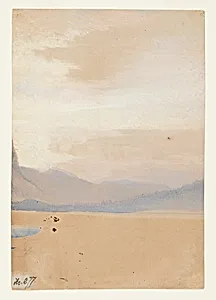
American Plains with Mountain Range in the Distance
Medium
landscapes
Classification
landscapes
Department
Smithsonian Collection
Museum
Smithsonian American Art Museum
Credit
Gift of Thomas Moran
Accession Number
1917-17-15-a
Rights
Public Domain
About this artwork
Research in Progress
Art Historical Context
Thomas Moran (1837–1926), a British-born American painter renowned for his luminous landscapes, captures the vastness of the American West in *American Plains with Mountain Range in the Distance*, created before 1872. As a key figure in the Hudson River School, Moran celebrated the sublime beauty of untamed wilderness, often drawing from his travels to evoke national pride and a sense of divine grandeur. This early work reflects his growing fascination with the expansive plains and distant peaks, predating his iconic Yellowstone expeditions that helped establish America's first national park. Moran's technique emphasizes dramatic lighting and atmospheric effects, hallmarks of Luminism, where subtle gradations of light create a glowing, ethereal quality across rolling grasslands and hazy mountains. Painted likely in oil or watercolor—a medium he mastered for its portability during sketching trips—the piece underscores the 19th-century Romantic ideal of nature's majesty amid westward expansion. A cherished gift from Moran himself to the Smithsonian American Art Museum, this landscape invites visitors to ponder the artist's role in shaping perceptions of America's frontier, blending personal vision with cultural heritage. (198 words)