
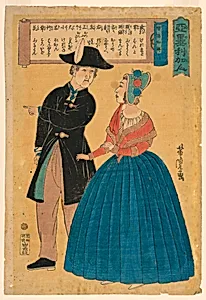
An American Officer Indicating Directions to his Wife ("Amerikajin"), from "Japanese Translations of Barbarian Words ("Bango wakai")
Medium
Classification
Department
Smithsonian Collection
Museum
Smithsonian American Art Museum
Credit
Gift of Hamill and Barker
Accession Number
1961-105-154
Rights
Public Domain
About this artwork
Research in Progress
Art Historical Context
In 1863, during Japan's turbulent Bakumatsu era—just before the Meiji Restorationukiyo-e artist Yoshitoratagawa captured the growing fascination with Westerners in his woodblock printAn American Officer Indicating to his Wife ("Amerajin")*. Part of the series *Japanese Translations of Barb Words ("Bango wak")*, this lively image humorously depicts an American officer directions to his wife, blending Japanese visual traditions with exotic "barbarian" subjects. Yoshitora, active from the 1850s to 1870s in the Utagawa school, was renowned for his colorful, detailed prints that reflected everyday life and current events. The artwork's historical significance lies in its reflection of Japan's uneasy encounter with the West following Commodore Perry's arrival in 1853, which forced open trade ports and sparked "yokushō-e" (foreign scenes) in ukiyo-e. These prints often satirized or exoticized foreigners, helping Japanese viewers make sense of unfamiliar customs amid rapid modernization. The title's "Amerikajin" label underscores linguistic curiosity, translating "barbarian" terms into playful illustrations. Crafted as a nishiki-e (brocade print) with vibrant colors from multiple woodblocks, it showcases ukiyo-e's technical mastery—precise lines, bold patterns, and dynamic composition. Now in the Smithsonian American Art Museum's collection (gift of Hamill and Barker), this piece invites us to ponder cultural exchange through art. (198 words)