
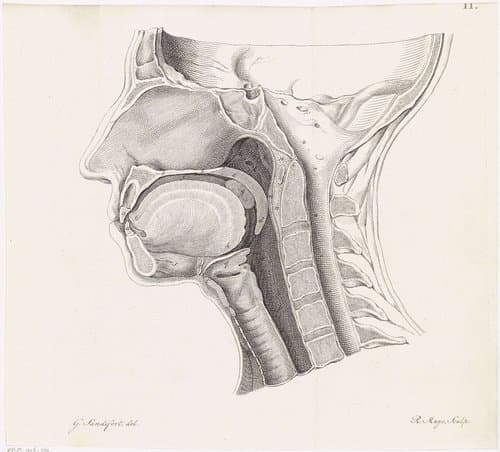
Anatomie van het hoofd
1752 - 1825
Medium
etching
Dimensions
259; 285
Rights
Public Domain
About this artwork
Anatomische doorsnede van een hoofd.
Art Historical Context
This etching by Robbert Muys, titled *Anatomie van het hoofd*, offers a precise anatomical cross-section of the human head. Created between 1752 and 1825, the work measures 259 by 285 millimeters and exemplifies the period’s growing fascination with scientific observation. Muys employed the etching technique to render delicate lines and intricate details, allowing viewers to study the skull, brain, and facial structures with clarity. Such anatomical prints played a vital role during the Enlightenment, when artists and physicians collaborated to advance medical knowledge. Etchings like this one were often included in textbooks or displayed in academic settings, helping to educate students and the public about human anatomy. The cross-sectional view reveals both external features and internal layers, blending artistic skill with scientific accuracy. Today, the work stands as a testament to the enduring partnership between art and science. Its careful craftsmanship continues to invite viewers to appreciate the complexity of the human body while reflecting the era’s commitment to empirical study.
About the Artist
Robbert Muys · 1742–1825
Robert (or Robbert) Muys (1742–1825) was a Dutch engraver whose long career spanned the late eighteenth and early nineteenth centuries, a period of dramatic political change in the Netherlands. Married to Maria Nozeman, Muys exemplified the professional engraver whose workshop practice combined technical skill with entrepreneurial organization. His work encompassed various subjects typical of Dutc...