
Ancient Ruins in the Interior
1865
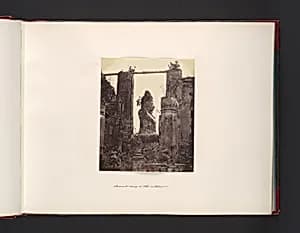
Medium
Albumen silver print from glass negative
Dimensions
19.7 × 16.7 cm (7 3/4 × 6 9/16 in.)
Classification
Photographs
Department
Photographs
Museum
Metropolitan Museum of Art, New York, NY
Credit
Gilman Collection, Purchase, Cynthia Hazen Polsky Gift, 2005
Accession Number
2005.100.583 (17a)
Rights
Public Domain
Art Historical Context
Step into the shadowy depths of history with *Ancient Ruins in the Interior a captivating 1865 albumen silver print pioneering photographer John Thomson. Captured at 19.7 × 16.7 cm, this intimate image from a glass negative transports viewers to forgotten architectural wonders, likely evoking the grandeur of ancient Asian structures Thomson documented during his extensive travels in the mid-19th century. son, a Scottish innovator in travel photography, mastered the wet-collodion process to produce glass negatives that yielded remarkably detailed albumen prints—coated with egg whites for rich tones and sharp clarity. This medium, dominant from the 1850s to 1890s, revolutionized visual documentation, allowing precise records of remote sites inaccessible to painters. His work bridged East and West, preserving vanishing cultures for global audiences. Housed in The Metropolitan Museum of Art's Gilman Collection, this photograph highlights photography's rise as an artistic and scientific tool, blending exploration with artistry. Imagine Thomson's lantern-lit darkroom amid ruins, coaxing light from stone— a testament to human curiosity and technological triumph.
About the Artist
John Thomson · 1837–1921
John Thomson (1837–1921), a pioneering Scottish photographer, was born on 14 June 1837 in Edinburgh as the eighth of nine children to William Thomson, a tobacco spinner and trader, and Isabella Newlands.) After schooling in the early 1850s, he apprenticed with a local optical and scientific instrument manufacturer, where he mastered the principles of photography, completing his training around 185...