
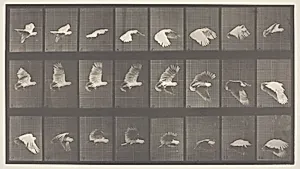
Animal Locomotion, Plate 758
Medium
Collotype, from "Animal Locomotion"
Dimensions
Image: 20.5 × 36.8 cm (8 1/8 × 14 1/2 in.); Paper: 48.4 × 61.4 cm (19 1/16 × 24 3/16 in.)
Classification
photograph
Department
Photography and Media
Museum
Art Institute of Chicago
Accession Number
195560
Rights
Public Domain
About this artwork
In the late 1870s, Eadweard Muybridge pioneered a method of "instantaneous photography," a technique developed to freeze time by capturing motion. In order to create such sequences, he set up a battery of cameras, 24 in this instance, connected by a clockwork mechanism that triggered the shutters one by one at rhythmic intervals. Muybridge initially devised this process to clarify the movement of horses; through his experiments, he demonstrated that all four hooves leave the ground mid-gallop, t...
Art Historical Context
Step into the pioneering world of motion capture with *Animal Locomotion, Plate 758* by Eadweard Muy, created in 1887. This collotype print, part of his monumental 11-volume portfolio *Animal Locomotion*, features a sequence of photographs that freeze the fluidity of movement in exquisite detail. Housed in the Art Institute of Chicago's and Media department, the image measures 20.5 × 368 cm, printed on larger 48.4 × 61.4 cm paper, allowing viewers to pore over every nuanced gesture. Muybridge, a British-American photographer, revolutionized visual science in the late 19th century through chronophotography—using a battery of up to 24 cameras triggered by electro-mechanical shutters to dissect animal and human locomotion. Commissioned initially by railroad magnate Leland Stanford to settle a bet about whether a trotting horse ever lifts all four hooves off the ground, Muybridge's work proved it did, shattering artistic conventions of the era. Collotype, a photomechanical printing process, enabled precise, large-scale reproductions of these sequential exposures, making scientific imagery accessible to artists, anatomists, and the public. This plate exemplifies how Muybridge's innovations bridged photography, science, and art, paving the way for cinema and modern motion studies. A testament to Victorian curiosity, it invites us to marvel at the poetry hidden in split-second reality.
About the Artist
Eadweard Muybridge · 1830–1904
Eadweard Muybridge (1830-1904) was an English-American photographer who revolutionized the understanding of motion through his pioneering chronophotographic studies. Born Edward James Muggeridge in Kingston upon Thames, England, he emigrated to America and became famous first for his dramatic landscape photographs of Yosemite Valley, then for his groundbreaking motion studies that proved horses li...