
Anna van Hannover, prinses van Oranje-Nassau, penning geslagen op last van de stad Sneek
1752 - 1759
Medium
striking (metalworking)
Dimensions
4.4; 60.13
Rights
Public Domain
About this artwork
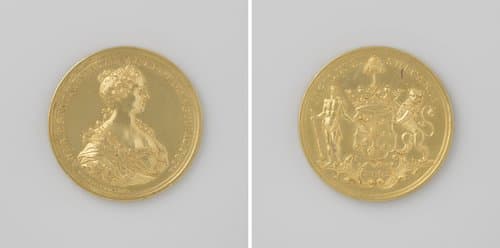
Gouden penning. Voorzijde: borststuk vrouw met diadeem binnen omschrift. Keerzijde: gekroond wapenschild, bekroond door een oranjeboom, geflankeerd door Herkules met knots en leeuwehuid en een leeuw boven cartouche met opschrift
Art Historical Context
This exquisite gold medal, struck by master medallist Nicolaas van Swind between 1752 and 1759, honors Anna Hannover, Princess of Orangeassau. Commissioned the city of Sneek Friesland, it celebrates noble status within the powerful House of Orange, rulers of the Dutch Republic. Measuring just 4.4 cm in diameter and weighing a substantial 60.13 grams, its luxurious craftsmanship reflects the era's admiration for commemorative art as a symbol of loyalty and prestige. The obverse features a detailed bust of Anna adorned with a diadem, encircled by an inscription that likely proclaims her titles. On the reverse, a crowned coat of arms rises beneath an orange tree—a potent emblem of the Orange-Nassau dynasty—flanked by the heroic figure of Hercules wielding his club and lion skin, alongside the fierce Dutch lion. These motifs evoke strength, heritage, and national pride, blending classical mythology with Dutch iconography in the struck metalworking technique, which allowed for sharp, intricate details through precision dies. As a product of 18th-century Dutch medal art, this piece highlights the cultural role of such tokens in civic ceremonies and political allegiance during the Republic's later years, offering visitors a tangible glimpse into Enlightenment-era nobility and regional devotion.