
Viervoudig verbond van Londen tussen Oostenrijk
1718
Medium
striking (metalworking)
Dimensions
5.5; 60.58
Rights
Public Domain
About this artwork
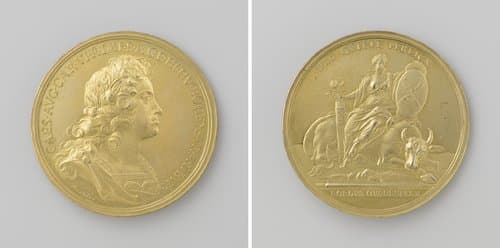
Voorzijde: borststuk man met lauwerkrans binnen omschrift. Keerzijde: vrouw met wapenschild, roedenbundel met bijl en roos zittend op rug van liggende stier binnen omschrift; afsnede: opschrift
Art Historical Context
This striking medal, created by Bengt Richter in 1718, commemorates the Quadruple Alliance of London, a pivotal diplomatic agreement involving Austria and its allies. Measuring just 5.5 centimeters in diameter, the piece exemplifies the refined art of medal-making through striking, a metalworking technique that allowed for precise, reproducible designs on silver or similar alloys. The obverse features a laurel-wreathed bust of a prominent figure—likely Emperor Charles VI—encircled by an inscription, while the reverse presents an allegorical scene: a seated female figure holding a coat of arms, fasces with axe, and rose, perched atop a recumbent bull, symbolizing unity and strength amid the treaty’s aims. Historically, the medal captures a moment of European stabilization following the War of the Spanish Succession. The 1718 alliance sought to curb Spanish expansion in Italy and maintain the balance of power among Britain, France, the Dutch Republic, and Austria. Richter’s work reflects the Baroque-era tradition of commemorative medals, which served both as diplomatic gifts and public records of state events, blending portraiture with symbolic imagery to convey political messages. As a struck artifact weighing 60.58 grams, it highlights the technical skill of early eighteenth-century medalists in capturing intricate details within a compact format. Such pieces remain valuable for understanding how art and politics intertwined to shape public memory of international treaties.