
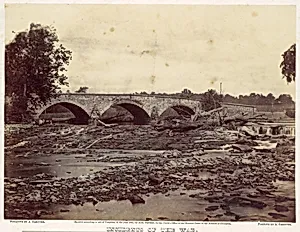
Antietam Bridge, On the Sharpsburg and Boonsboro Turnpike, No. 2, September 1862
Medium
Albumen silver print from glass negative
Classification
Photographs
Department
Photographs
Museum
Metropolitan Museum of Art, New York, NY
Credit
Purchase, Florance Waterbury Bequest, 1970
Accession Number
1970.537.11
Rights
Public Domain
Tags
Art Historical Context
Alexander Gardner's *Antietam Bridge, On thepsburg and Boons Turnpike, No. 2, September 1862* captures a pivotal moment from the American Civil War'siest single-day battle. Taken just days after the Battle of Antietam on September 17 1862, thisen silver print from a negative depicts the sturdy stone bridge along a vital turnpike in Maryland. Gardner, a pioneering Scottish-born photographer who worked with Mathew Brady, arrived on the scene with his team to document the war's grim aftermath, offering one of the earliest visual records of such devastation. The bridge, known today as Burnside's Bridge, was a strategic chokepoint where Union forces under General Ambrose Burnside struggled to cross the Antietam Creek amid fierce Confederate resistance, contributing to over 22,000 casualties that day. Gardner's image, part of a numbered series, conveys the eerie stillness of the battlefield, with its architectural solidity contrasting the human tragedy it witnessed. As a photograph rather than a painting, it brought the war's reality into Northern living rooms, shifting public perception and supporting the Union cause. Crafted via the albumen process—coating paper with egg whites and silver salts for exceptional detail and tonal range—this print exemplifies mid-19th-century photographic innovation. Housed in the Metropolitan Museum of Art, it stands as a testament to photography's emerging role in history, preserving a landscape forever scarred by conflict.
About the Artist
Alexander Gardner · 1840–1882
Alexander Gardner was born on 17 October 1821 in Paisley, Renfrewshire, Scotland, and came of age in a culture shaped by radical social thought. Influenced by the cooperative ideals of Robert Owen, Gardner initially apprenticed as a jeweler and harbored dreams of founding a utopian community in America. His encounter with photography changed the course of his life. After seeing Mathew Brady's cele...