
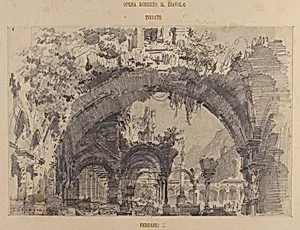
Architectural Ruins with a View of a Garden; Stage design for Giacomo Meyerbeer's opera, "Robert le diable"
1845–1907
Medium
Graphite; partly squared in graphite
Dimensions
Overall: 12 1/2 x 18 15/16 in. (31.8 x 48.1 cm) image: 6 15/16 x 10 7/16 in. (17.6 x 26.5 cm)
Classification
Drawings
Department
Drawings and Prints
Museum
Metropolitan Museum of Art, New York, NY
Credit
The Elisha Whittelsey Collection, The Elisha Whittelsey Fund, 1962
Accession Number
62.570.22
Rights
Public Domain
Tags
Art Historical Context
This graphite drawing by Italian artist Carlo Ferrario captures a haunting stage design for Giacomo Meyerbeer’s 1831 opera *Robert le diable*. Created during Ferrario’s long career (1845–1907), the work depicts crumbling architectural ruins opening onto a tranquil garden. Such evocative scenery was essential to the opera’s Romantic atmosphere, where supernatural drama unfolds amid medieval settings that heighten the story’s mystery and emotional intensity. Ferrario’s technique—pencil lines partly squared for enlargement—reveals the practical process of transforming a small sketch into a full theatrical backdrop. The contrast between decaying stone and lush garden foliage would have been painted in dramatic chiaroscuro on stage, guiding the audience’s eye while supporting the singers’ movements. Now preserved at the Metropolitan Museum of Art, the sheet offers a rare glimpse into 19th-century opera production, illustrating how designers like Ferrario blended architectural fantasy with natural beauty to transport viewers into Meyerbeer’s gothic world.
About the Artist
Carlo Ferrario · 1833–1907
**Carlo Ferrario** (7 September 1833 – 11 May 1907) was an Italian scenic and costume designer, painter, and architect renowned for his contributions to opera and theater design, particularly his long association with La Scala in Milan. Born in Milan to a blacksmith father, Giuseppe Ferrario, and mother Francesca Basulli, he left school early to support himself, taking a job with a local decorator...