
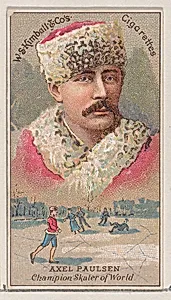
Axel Paulsen, Champion Skater of the World, from the Champions of Games and Sports series (N184, Type 1) issued by W.S. Kimball & Co.
Medium
Commercial color lithograph
Dimensions
Sheet: 2 11/16 × 1 1/2 in. (6.8 × 3.8 cm)
Classification
Prints|Ephemera
Department
Drawings and Prints
Museum
Metropolitan Museum of Art, New York, NY
Credit
The Jefferson R. Burdick Collection, Gift of Jefferson R. Burdick
Accession Number
63.350.216.184.16
Rights
Public Domain
Tags
Art Historical Context
Step into the vibrant world of 19th sports fandom with this tiny gem: *Axel Paulsen, Champion Skater of the World*, a commercial color lithograph from W.S. Kimball & Cos *Champions of Games and* series (N184, Type 1), issued in 188. Measuring just 2 11/16 × 1 1/2 inches, this ephemera captures the Norwegian speed skater Axel Paulsen mid-stride on ice, his poised athleticism rendered in bold, eye-catching hues typical of chromolithography—a printing technique that brought affordable, vivid color to mass-produced images. Produced by the American tobacco company W.S. Kimball & Co., these cards were savvy marketing inserts for cigarette packs, fueling a collecting craze among enthusiasts. Paulsen, a trailblazing figure skater dubbed the "world champion," embodied the era's growing obsession with athletic heroes amid the rise of organized sports. Housed in the Metropolitan Museum of Art's Jefferson R. Burdick Collection, this print highlights how everyday commerce celebrated physical prowess, bridging art, advertising, and popular culture in Gilded Age America. Though ephemeral by design, its preservation underscores the cultural snapshot it offers: a time when skating stars shone as brightly as any canvas masterpiece, inviting us to skate through history.
About the Artist
W.S. Kimball & Co.
William S. Kimball & Co. was a tobacco manufacturer based in Rochester, New York, whose influence extended well beyond the cigarette trade into the realm of popular visual culture. Founded in 1846 by William S. Kimball and James C. Hart, the company grew into one of the largest tobacco concerns in the United States, erecting a landmark factory along the Erie Canal on Court Street in 1880. The buil...