
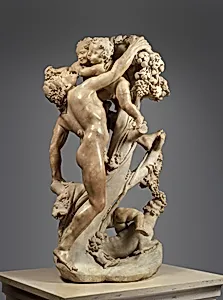
Bacchanal: A Faun Teased by Children
ca. 1616–17
Medium
Marble
Dimensions
Overall (confirmed): 52 1/8 × 29 × 18 7/8 in., 529 lb. (132.4 × 73.7 × 47.9 cm, 240 kg)
Classification
Sculpture
Culture
Italian, Rome
Department
European Sculpture and Decorative Arts
Museum
Metropolitan Museum of Art, New York, NY
Credit
Purchase, The Annenberg Fund Inc. Gift, Fletcher, Rogers, and Louis V. Bell Funds, and Gift of J. Pierpont Morgan, by exchange, 1976
Accession Number
1976.92
Rights
Public Domain
Tags
Art Historical Context
In the lively marble sculpture *Bacchanal: A Faun Teased by Children* (ca. 1616–17), young Gian Lorenzo Bernini, with assistance from his father Pietro Bern, captures a whimsical moment from classical mythology. A tipsy faun—a half-man, halfat woodland spirit—reclines amid a playful melee of putti (chubby childlike figures), who tease him with grapes, tug at his tail, and clamber over his muscular form. Details like scampering salamanders, lion skins, and scattered grapes evoke the exuberant chaos of a Roman bacchanal, a Dionysian revelry celebrating wine and abandon. Created in Rome during the early Baroque era, this work showcases Bernini's prodigious talent at just 18 years old. The Berninis' intricate marble carving brings lifelike energy to the stone: the faun's textured fur, soft childlike flesh, and rippling muscles seem to pulse with movement, foreshadowing Gian Lorenzo's mastery of illusionistic sculpture. Standing over four feet tall and weighing half a ton, its scale amplifies the scene's theatricality, a hallmark of the period's shift from Renaissance restraint to emotional dynamism. Housed in the Metropolitan Museum of Art's European Sculpture collection, this piece highlights Rome's vibrant artistic scene under papal patronage, blending pagan joy with Christian-era virtuosity. It's a delightful window into Bernini's early genius, blending humor, sensuality, and technical bravura.
About the Artist
Gian Lorenzo Bernini|Pietro Bernini · 1598–1680
Italian sculptor, architect, painter, and designer who is considered to be the supreme artist of the Italian Baroque. His important patrons included the Barberini and Borghese families. Italian architect. Comment on works: sculptor