
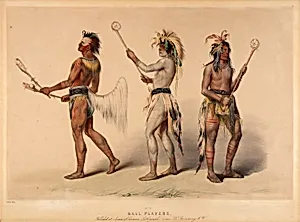
Ball Players
n.d.
Medium
Graphic Arts-Print
Classification
Graphic Arts-Print
Department
Smithsonian Collection
Museum
Smithsonian American Art Museum
Credit
Smithsonian American Art Museum, Gift of Mrs. Joseph Harrison, Jr.
Accession Number
1966.48.68
Rights
Public Domain
Tags
Art Historical Context
**Ball Players** by George Catlin captures a dynamic moment of Native American life, depicting male figures engaged in a traditional ball game. As a pioneering 19th-century artist and ethnographer, Catlin traveled extensively across the American West in the 1830s, sketching and painting Indigenous peoples to document their cultures before rapid colonization altered them forever. This undated print, housed in the Smithsonian American Art Museum, reflects his commitment to preserving these vibrant traditions through art. Catlin's works belong to the Romantic tradition, blending keen observation with a sense of admiration for Native American vitality—what he called the "noble savage." The scene likely portrays a game akin to stickball or lacrosse, central to many tribes' social and spiritual rituals, fostering community bonds and athletic prowess among men. Produced as a graphic arts print—possibly a lithograph from his original oil paintings or sketches—this medium allowed wider dissemination of his images, bringing Indigenous customs to Eastern audiences hungry for tales of the frontier. Today, **Ball Players** stands as a poignant historical record, highlighting the physical grace and cultural depth of Native American games amid encroaching change. Gifted to the Smithsonian by Mrs. Joseph Harrison, Jr., it invites visitors to appreciate Catlin's role in early American visual anthropology. (198 words)
About the Artist
George Catlin · 1796–1872
George Catlin (1796–1872), born in Wilkes-Barre, Pennsylvania, to Putnam Catlin and Polly Sutton—who had been captured by Native Americans during the 1778 Battle of Wyoming—initially pursued a legal career. Trained at Litchfield Law School, he was admitted to the bar in 1819 but abandoned law after two years to study art in Philadelphia in 1823. Self-taught as a portraitist, Catlin quickly gained ...