
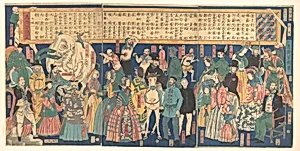
Bankoku danjō jimbutsu zue|Picture of Men and Women from all nations (Bankoku danjo jinbutsu zue)
4th month, 1861
Medium
Triptych of woodblock prints; ink and color on paper
Dimensions
Image (a): 14 3/4 x 10 in. (37.5 x 25.4 cm) Image (b): 14 3/4 x 10 in. (37.5 x 25.4 cm) Image (c): 14 3/4 x 10 in. (37.5 x 25.4 cm)
Classification
Prints
Culture & Period
Japan · Edo period (1615–1868)
Department
Asian Art
Museum
Metropolitan Museum of Art, New York, NY
Credit
Bequest of William S. Lieberman, 2005
Accession Number
2007.49.230a–c
Rights
Public Domain
Tags
Art Historical Context
**Bankoku Danjō Jinbutsu Zue (Picture of Men and Women from All Nations)** Created by Utagawa Yoshiiku in the 4th month of 1861, this vibrant triptych of woodblock prints exemplifies the late Edo period's fascination with the wider world. Yoshiiku, a prominent artist from the Utagawa school renowned for ukiyo-e prints, crafted this work using ink and color on paper, with each of the three sheets measuring 14¾ × 10 inches. Assembled side-by-side, the panels form a panoramic scene, a format beloved in Japanese printmaking for its immersive storytelling. The title reveals its subject: depictions of men and women from diverse nations, accompanied by exotic animals like elephants and horses. Produced during Japan's Edo period (1615–1868), amid growing encounters with foreigners following the end of sakoku isolation, the print captures a moment of cultural curiosity. Woodblock triptychs like this allowed artists to showcase intricate details and bold colors through layered printing techniques, making global wonders accessible to everyday viewers. Housed in the Metropolitan Museum of Art's Asian Art Department, this bequest from William S. Lieberman highlights Yoshiiku's skill in blending Japanese aesthetics with international motifs. It offers a window into how 19th-century Japan imagined the world beyond its shores, inviting us to marvel at its lively portrayal of humanity's vast tapestry.
About the Artist
Utagawa Yoshiiku · 1833–1904
Utagawa Yoshiiku (1833–1904) was a prolific Japanese woodblock print artist and journalist who lived through one of the most turbulent and transformative periods in his country's history, the transition from the Edo period through the Meiji Restoration. A student of the celebrated Utagawa Kuniyoshi, Yoshiiku inherited his master's taste for bold compositional drama and dynamic figuration, applying...