
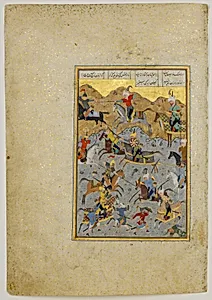
"Battle between Alexander and Darius", Folio 279 from a Khamsa (Quintet) of Nizami of Ganja
A.H. 931/1524–25 CE
Medium
Ink, opaque watercolor, and gold on paper
Dimensions
Painting: H. 7 3/8 in. (18.7 cm) W. 4 13/16 in. (12.2 cm) Page: H. 12 5/8 in. (32.1 cm) W. 8 3/4 in. (22.2 cm) Mat: H. 19 1/4 in. (48.9 cm) W. 14 1/4 in. (36.2 cm)
Classification
Codices
Department
Islamic Art
Museum
Metropolitan Museum of Art, New York, NY
Credit
Gift of Alexander Smith Cochran, 1913
Accession Number
13.228.7.15
Rights
Public Domain
Tags
Art Historical Context
This vibrant folio, titled *Battle between Alexander and Darius*, comes from Folio 279 of Nizami Ganjavi's *Khamsa* (Quintet), a celebrated collection of five epic poems completed in the 12th century. Created in 1524–25 CE by the master painter Sultan Muhammad Nur during the Safavid dynasty in Persia, it captures a dramatic moment from the *Iskandarnama* (Book of Alexander), depicting the legendary clash between Alexander the Great (Iskandar) and Persian king Darius III. In Islamic tradition, Alexander is revered as a wise prophet-king, blending historical conquest with moral allegory. Rendered in ink, opaque watercolor, and gold on paper, the miniature exemplifies Persian illumination techniques. Fine ink outlines define dynamic figures of charging warriors and rearing horses, while vivid colors and gold accents create depth and movement on the compact 7⅜ × 4⅞-inch painting surface. This codex style, typical of royal Safavid ateliers, transformed manuscripts into treasures of storytelling art. Housed in the Metropolitan Museum of Art's Islamic Art Department since 1913, this piece highlights the cultural fusion of Persian literature, history, and miniature painting, inviting viewers to ponder timeless themes of power and heroism amid swirling battle chaos.