
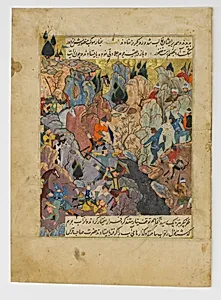
"Battle Scene", Folio from a Zafarnama (Book of Victories) of Sharaf al-Din 'Ali Yazdi
1485–86
Medium
Ink, watercolor, and gold on paper
Dimensions
Painting: H. 9 3/8 in. (23.8 cm) W. 6 1/2 in. (16.5 cm) Page: H. 12 in. (30.5 cm) W. 8 7/16 in. (21.5 cm) Mat: H. 19 1/4 in. (48.9 cm) W. 14 1/4 in. (36.2 cm)
Classification
Codices
Department
Islamic Art
Museum
Metropolitan Museum of Art, New York, NY
Credit
Rogers Fund, 1943
Accession Number
43.138
Rights
Public Domain
Tags
Art Historical Context
This vibrant folio, titled "Battle Scene," comes from the *Zafarnama* (Book of Victories), lavish 15th-century manuscript chronicling the conquests of Timur (Tamerlane), theco-Mongol conqueror. Written by the Persian historian Sharaf al-D 'Ali Yazdi, the text was copied and illustrated around 1485–86 in the Timurid artistic tradition, likely in Herat or Shiraz. As part of a codex in the Metropolitan Museum of Art's Islamic collection, it captures the chaos and glory of battle with dynamic figures of soldiers, men, and rearing horses locked in combat. Executed in ink, watercolor, and gold on paper, the miniature exemplifies Persianate illumination techniques. Fine ink outlines define the figures against a patterned landscape, while delicate watercolors bring vivid life to armor, banners, and steeds. Gold accents heighten the drama, evoking the splendor of Timurid courts. Measuring about 9⅜ × 6½ inches, its intimate scale invites close viewing, typical of folios meant for scholarly admiration. Culturally, this artwork glorifies Timur's legacy, blending history with heroic narrative in a style that influenced later Mughal and Safavid painting. Acquired through the Rogers Fund in 1943, it offers a window into the Islamic world's masterful blend of literature and visual storytelling.