
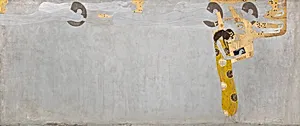
Beethovenfries: Die Sehnsucht nach Glück findet Stillung in der Poesie - Tafel 7, rechte Langwand
1901/1902
Medium
Kaseinfarben, Stuckauflagen, Zeichenstift, Applikationen aus verschiedenen Materialien (Glas, Perlmutt etc.), Goldauflagen auf Mörtel
Dimensions
215 x 516 cm
Classification
Wandbild
Department
Belvedere Collection
Museum
Belvedere
Credit
Belvedere, Vienna
Accession Number
5987/7
Rights
Public Domain
About this artwork
Die schwebenden Genien gelangen zur Figur der "Poesie", die als Sängerin mit Lyra dargestellt ist. Klimt adaptierte für diese Figur seine Darstellung der "Musik" für den Musiksalon des Palais Dumba (1945 verbrannt, eine 1895 datierte Ölstudie existiert in der Neuen Pinakothek in München).
Art Historical Context
Step into the shimmering world of Gustav Klimt *Beethoven Frieze*, a monumental masterpiece from Vienna's Secessionist movement. Created in 1901/1902 for the 14th Exhibition of the Vienna Secession this sprawling wall painting—over 34 meters long—honors Ludwig van Beethoven's Ninth Symphony Panel 7, *Die Sehnsucht nach findet Stillung in Poesie* (Longing for Happiness Finds Solace in Poetry), graces the right long wall, an imposing 215 x 516 cm. Housed in Vienna's Belvedere Collection, it captures the era's yearning for spiritual elevation through art. In this panel, ethereal floating genii drift toward the central figure of "Poesie," portrayed as a lyrical singer cradling a lyre. Klimt masterfully adapts his earlier depiction of "Musik" from the lost Palais Dumba music salon (destroyed in 1945; an 1895 oil study survives in Munich's Neue Pinakothek). His technique dazzles: casein paints on mortar layered with stucco reliefs, gold overlays, and luxurious applications of glass, mother-of-pearl, and more, evoking a dreamlike, jewel-encrusted aura typical of his Symbolist style. This frieze symbolizes humanity's quest for transcendence amid modern chaos, blending mythology, music, and poetry in opulent ornamentation. A testament to Klimt's innovative fusion of painting and sculpture, it remains a pinnacle of fin-de-siècle Viennese art, inviting viewers to lose themselves in its poetic embrace.
About the Artist
Gustav Klimt · 1862–1918
Gustav Klimt was born on July 14, 1862, in Baumgarten near Vienna, the second of seven children in a modest family of artistic bent. His father, Ernst Klimt, a gold engraver who had immigrated from Bohemia, and his mother, Anna Finster, an aspiring musician, instilled an early appreciation for craft and creativity amid financial hardship. Klimt displayed prodigious drawing talent, prompting his en...