
Beleg van Groningen
1672
Medium
casting
Dimensions
63.23; 7.5
Rights
Public Domain
About this artwork
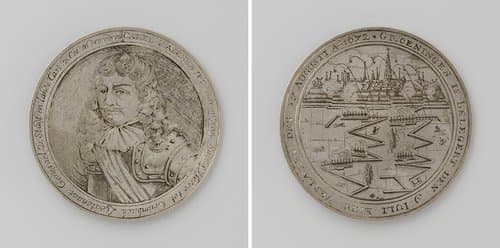
Zilveren penning. Voorzijde: borststuk man binnen omschrift. Keerzijde: gezicht op stad en belegeraars tijdens beschieting binnen omschrift.
Art Historical Context
Step into the turbulent world of 17th-century Europe with *Beleg van Groningen*, finely crafted silver medal from 1672, created anonymously through casting techniques. Measuring just 7.5 cm in diameter and weighing 63.23 grams, this artifact packs a punch of historical drama. Struck during the chaotic "Rampjaar" (aster Year) of the Republic, it commemorates the dramatic Siege of Groningen—a pivotal clash in the Third Anglo-D War, where French, Münster, and allied forces the staunchly defended city. The obverse features a detailed bust of a man, likely a key figure in the conflict, encircled by an inscription that adds a layer of narrative gravitas. Flip it over to the reverse, and you're greeted by a vivid scene of the city under siege: beleaguered walls, besiegers, and cannon fire captured in miniature relief, all framed by another inscription. Such medals were prized 17th-century souvenirs, blending artistry with propaganda to honor—or rally around—military exploits. As a snapshot of Baroque-era medal-making, *Beleg van Groningen* highlights the era's mastery of intricate casting on silver, making grand events portable and personal. It invites us to ponder resilience amid invasion, a timeless theme etched in gleaming metal. (198 words)
About the Artist
anonymous
In the vast tapestry of art history, "Anonymous" stands not as a singular individual but as a collective designation for countless unidentified creators whose works have endured across millennia. These artists, spanning prehistoric cave painters to medieval illuminators and folk craftsmen, produced the foundational layers of human visual culture. Prior to the Renaissance, when individual fame emer...