
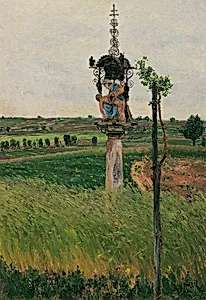
Bildstöckl, Lundenburg
um 1892
Medium
Öl auf Leinwand
Dimensions
55 x 38,5 cm
Classification
Gemälde
Department
Belvedere Collection
Museum
Belvedere
Credit
Belvedere, Vienna
Accession Number
2542
Rights
Public Domain
Art Historical Context
Theodor von Hörmann's *Bildstöckl, Lundenburg* (c. 1892) captures a quaint wayside shrine—or *Bildstöckl*—nestled in the Moravian town of Lundenburg (now Břeclav, Czech Republic). Painted in oil on canvas, this intimate 55 x 38.5 cm work exemplifies Hörmann's affinity for Central European landscapes and vernacular architecture. As an Austrian artist active in the late 19th century, Hörmann often depicted rural scenes with a keen eye for atmospheric detail, bridging Realism and the emerging impressionistic tendencies of his era. The modest scale suggests this was perhaps a study or personal meditation, rendered with meticulous brushwork typical of oil on canvas techniques that allowed for rich textures and subtle light effects. Created around 1892, during a period of cultural flourishing in the Austro-Hungarian Empire, the painting reflects nostalgia for fading folk traditions amid rapid modernization. *Bildstöckl* shrines, devotional structures honoring saints, were cultural touchstones in Catholic regions like Moravia, symbolizing community faith and the harmony between humanity and nature. Housed in Vienna's Belvedere Collection, this gem invites visitors to ponder everyday spirituality through Hörmann's lens. Its preservation highlights the museum's commitment to 19th-century Austrian painting, offering a window into a serene, bygone world. (198 words)