
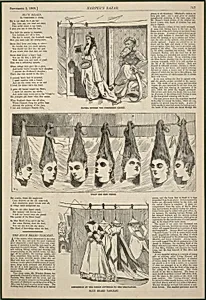
Blue Beard Tableau, from Harper's Bazar, September 5, 1868
1868
Medium
Graphic Arts-Print
Classification
Graphic Arts-Print
Department
Smithsonian Collection
Museum
Smithsonian American Art Museum
Credit
Smithsonian American Art Museum, The Ray Austrian Collection, gift of Beatrice L. Austrian, Caryl A. Austrian and James A. Austrian
Accession Number
1996.63.160
Rights
Public Domain
Tags
Art Historical Context
**Blue Beard Tableau, from Harper Bazar, September , 1868** Winslow Homer, a pioneering American realist artist, created this wood engraving print for the pages of *Harper's Bazar* in 1868, during the vibrant post-Civil War era when illustrated magazines brought theater, fashion, and folklore to middle-class homes. Featured in the Smithsonian American Art Museum's collection, it captures a dramatic "tableau vivant"—a popular 19th-century entertainment where performers froze in posed scenes mimicking famous stories. Here, Homer illustrates a lively group of figures enacting the chilling fairy tale *Bluebeard* by Charles Perrault, complete with the infamous bloodstained key that unlocks the villain's deadly secret. The print's graphic arts medium highlights Homer's mastery of wood engraving, a technique demanding precise line work to convey texture, expression, and narrative in black and white. Tags like "figure group," "key," "written matter," and "performer" evoke costumed actors on stage, perhaps with props or signage adding textual drama. This work reflects Homer's early career as a magazine illustrator, bridging his Civil War sketches with later oil paintings of American life. Culturally, it underscores *Bluebeard*'s enduring fascination as a tale of curiosity, betrayal, and feminine peril, staged in parlors and theaters for amusement. Homer's keen observation infuses the scene with tension and humanity, making this snapshot a window into 1860s popular entertainment and the era's blend of whimsy and Gothic thrill. (218 words)
About the Artist
Winslow Homer · 1836–1910
Winslow Homer (1836-1910) was one of America's greatest painters and a preeminent figure in 19th-century American art. Largely self-taught, Homer began his career as a commercial illustrator and Civil War correspondent for Harper's Weekly before becoming renowned for his powerful marine subjects and landscape paintings. His mastery of both oil and watercolor, combined with his uncompromising reali...