
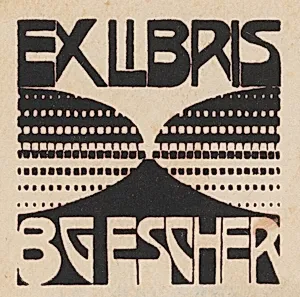
Bookplate B.G. Escher
probably 1922
Medium
metalcut (zinc) on wove paper
Dimensions
image: 3 x 3 cm (1 3/16 x 1 3/16 in.) sheet: 3.8 x 3.8 cm (1 1/2 x 1 1/2 in.)
Classification
Department
CG-E
Museum
National Gallery of Art, Washington, D.C.
Credit
Cornelius Van S. Roosevelt Collection
Accession Number
1983.109.21
Rights
Public Domain
Art Historical Context
**Bookplate B.G.** (probably 1922) is a delicate ex-libris designed by the young M.C. Escher, created as a personalized bookplate to mark ownership a private library. Measuring just 3 x 3 cm, this tiny print reflects the intimate, decorative tradition of bookplates popular among collectors in early 20th-century Europe. Likely made for a family member—B.G. Escher—this piece captures Escher at age 24, shortly after his studies at the School for Architecture and Decorative Arts in Haarlem, before his fame for mind-bending tessellations and impossible architectures. Escher executed it as a metalcut on wove paper, a rare and precise technique where the artist incises a zinc plate directly with a burin, bypassing acid etching for sharp, clean lines ideal for intricate small-scale designs. This medium highlights his early mastery of printmaking, showcasing fine detail in a format no larger than a postage stamp. Housed in the National Gallery of Art's Cornelius Van S. Roosevelt Collection, it offers a glimpse into Escher's foundational skills. Though modest in size, this bookplate foreshadows the Dutch artist's lifelong fascination with pattern and precision, bridging his initial landscape woodcuts and later mathematical marvels. A charming artifact of personal bibliophilia and technical innovation!
About the Artist
M.C. Escher · 1898–1972
Maurits Cornelis Escher (1898-1972) was a Dutch graphic artist renowned for his mathematically-inspired woodcuts, lithographs, and mezzotints featuring impossible constructions, tessellations, and explorations of infinity. Though he considered himself lacking in mathematical ability, Escher's work demonstrates profound intuitive understanding of geometry, symmetry, and spatial paradox. A transform...