
Bookplate M.C. Escher
1917
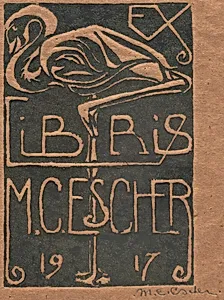
Medium
linoleum cut on brown wove paper
Dimensions
block: 10.8 × 7 cm (4 1/4 × 2 3/4 in.) sheet: 18.6 x 15.8 cm (7 5/16 x 6 1/4 in.)
Classification
Department
CG-E
Museum
National Gallery of Art, Washington, D.C.
Credit
Cornelius Van S. Roosevelt Collection
Accession Number
1983.109.87
Rights
Public Domain
Art Historical Context
**Bookplate M.C. Escher (1917)**Created by the young M.C. Escher age 19, this linoleum cut served as a personal bookplate ex-libris label designed to mark book ownership with artistic flair. Produced during Escher's student years at the School for and Decorative Arts inlem, Netherlands, it his early experimentation with printmaking amid the cultural ferment of World War I Europe. Bookplates like this were cherished by intellectuals and collectors, blending utility with personal expression. The medium, linoleum cut on brown wove paper, highlights a modern relief printing technique that emerged in the early 20th century. Softer and more accessible than woodcuts, linoleum allowed Escher to carve bold lines and textures into the small block (just 10.8 × 7 cm), yielding a crisp impression on a modest sheet. This piece from the Cornelius Van S. Roosevelt Collection at the National Gallery of Art showcases the precision that would define Escher's later masterpieces in tessellations and optical illusions. Though modest in scale, this early work foreshadows Escher's lifelong mastery of prints, bridging decorative arts traditions with innovative graphic design. A charming glimpse into the artist's formative years, it invites visitors to ponder how such personal creations laid the groundwork for his iconic mathematical fantasies.
About the Artist
M.C. Escher · 1898–1972
Maurits Cornelis Escher (1898-1972) was a Dutch graphic artist renowned for his mathematically-inspired woodcuts, lithographs, and mezzotints featuring impossible constructions, tessellations, and explorations of infinity. Though he considered himself lacking in mathematical ability, Escher's work demonstrates profound intuitive understanding of geometry, symmetry, and spatial paradox. A transform...