
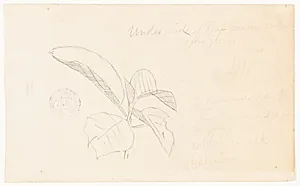
Botanical Study, Ecuador
Classification
Drawing
Department
Smithsonian Collection
Museum
Smithsonian American Art Museum
Credit
Gift of Louis P. Church
Accession Number
1917-4-224
Rights
Public Domain
About this artwork
Research in Progress
Art Historical Context
Frederic Edwin Church, leading figure of the Hudson River School, *Botanical Study, Ecuador in 1857 during of his expeditions to South America. Inspired by explorer Alexander von Humboldt, Church traveled to Ecuador in 1853 and again in 1857, the region's lush flora and dramatic volcanoes. This drawing captures his keen observation of nature, likely serving as a preparatory study for his monumental landscape paintings that celebrated the sublime beauty of the natural world. As a precise botanical rendering, the work exemplifies Church's mastery of detailed realism, a hallmark of the Hudson River School's luminist style, which emphasized light, atmosphere, and divine harmony in wilderness scenes. Though the medium is unknown, its classification as a drawing highlights Church's on-site fieldwork, blending scientific accuracy with artistic vision. Produced amid his Ecuador journeys, it reflects 19th-century American fascination with exotic landscapes and the era's Romantic idealization of untouched frontiers. Housed in the Smithsonian American Art Museum through a gift from Louis P. Church, this piece offers a rare glimpse into the artist's process. Visitors can appreciate how such intimate studies fueled epic canvases like *Heart of the Andes* (1859), bridging personal exploration with national identity in American art. (198 words)