
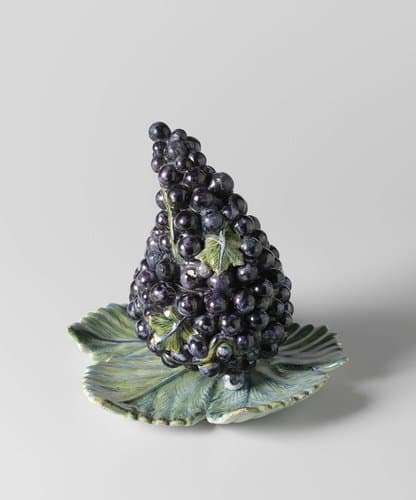
Botervloot of terrine in de vorm van een druiventros
ca. 1750 - ca. 1775
Medium
butter dish
Dimensions
13.5
Rights
Public Domain
About this artwork
Botervloot of terrine van faience. Bestaande uit een bak met deksel in de vorm van een druiventros, en een onderschotel in de vorm van een druivenblad.
Art Historical Context
Step into the whimsical world of 18th-century European tableware with this charming *Botervloot of terrine de vorm van een druros* (Butter Dish or Terrine in the Form of a Bunch Grapes), crafted anonymously around 1750–1775. Standing at about 13.5 cm high, this faience piece—a tin-glazed earthenware in the Netherlands and beyond—transforms a humble butter dish into a feast for the eyes. It features a bowl topped with a lid shaped like a plump cluster of grapes, paired with a saucer mimicking a broad grape leaf, blending utility with playful naturalism. Produced during the Rococo era, when opulent interiors favored delicate, organic motifs inspired by nature, this terrine exemplifies the era's delight in *nature morte* (still life) forms. Faience, fired at lower temperatures than porcelain, allowed artisans to create intricate, colorful shapes affordably, often in workshops like those in Delft. The grapes and leaf likely symbolize abundance and the vine's classical associations with Bacchus, god of wine, adding a touch of festivity to everyday dining. Though anonymous, the maker's skill in modeling soft, lifelike forms and glazing them to evoke dew-kissed freshness highlights faience's accessibility as an art form. A delightful survivor of lavish 18th-century banquets, it invites us to savor how even kitchenware could embody elegance and joy.
About the Artist
anonymous
In the vast tapestry of art history, "Anonymous" stands not as a singular individual but as a collective designation for countless unidentified creators whose works have endured across millennia. These artists, spanning prehistoric cave painters to medieval illuminators and folk craftsmen, produced the foundational layers of human visual culture. Prior to the Renaissance, when individual fame emer...