
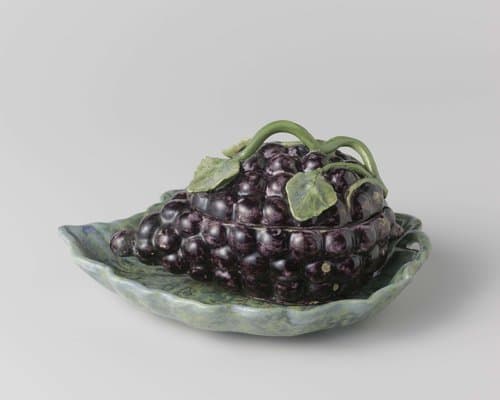
deksel van een doos in de vorm van een druiventros
1724 - 1764
Medium
lid
Dimensions
11; 9; 5.5
Rights
Public Domain
About this artwork
Legaat van de heer E. van Hoboken van Rhoon Pendrecht en Oudelande, Arnhem
Art Historical Context
Behold the whimsical *Deksel van een doos de vorm van een druros* (Lid of a Box in Shape of a Bunch ofes), a delightful 18th-century artifact crafted by De Porceleijne Schotel 1724 and 1764. Measuring a compact 11 cm high, 9 cm wide, and 5.5 cm deep, this porcelain lid captures the lush form of a grape cluster with remarkable naturalism, serving as the playful top to an absent box. Its medium as a standalone "lid" highlights the era's fascination with functional yet sculptural objects, blending utility with ornate decoration. Produced during the Dutch Golden Age's tail end, when Delftware workshops like De Porceleijne Schotel emulated finer Chinese porcelains, this piece reflects innovative tin-glazed earthenware techniques. Artisans molded and hand-painted such forms to mimic exotic imports, infusing everyday items with abundance and luxury—grapes symbolizing fertility and Bacchanalian revelry in European art. A cherished bequest from collector E. van Hoboken of Rhoon, Pendrecht, Oudelande, and Arnhem, it entered the museum's collection as a testament to 18th-century Dutch connoisseurship. Visitors, imagine it crowning a snuffbox or trinket case, evoking the opulent interiors of prosperous merchant homes.