
Bound print
Classification
Bound print
Department
Smithsonian Collection
Museum
Smithsonian American Art Museum
Credit
Purchased for the Museum by the Advisory Council
Accession Number
1921-6-543-54
Rights
Public Domain
About this artwork
Research in Progress
Art Historical Context
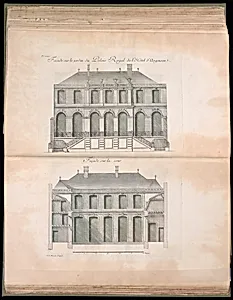
Germain Boffrand (7–1754), a leading French architect of the Rococo era, this *Bound Print* in 1745. Boffrand was renowned for elegant designs at Versailles and his influential publication *Livre d'architecture*, a bound volume of exquisite engravings showcasing ornate interiors, furniture, and decorative motifs. As a "bound print," this work likely originates from such a collection, where intricate etchings were compiled into books for architects, designers, and to study and replicate. Rococo artistry emphasized graceful curves, asymmetry, and playful ornamentation, reflecting the opulent tastes of 18th-century European aristocracy. Boffrand's prints were pivotal in spreading these styles across Europe, influencing architecture and interiors far beyond France. Though the exact medium remains under research, such prints—typically etched or engraved on paper—served as portable blueprints, democratizing high design. Acquired by the Smithsonian American Art Museum through its Advisory Council, this piece highlights transatlantic exchanges in artistic ideas. European prints like Boffrand's inspired early American builders, bridging Old World elegance with New World aspirations. Ongoing research promises to reveal more about its precise subject and technique, inviting visitors to ponder its role in shaping tastes across centuries.