
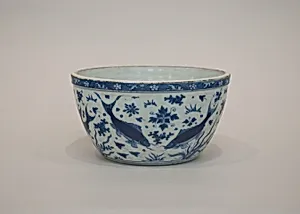
Bowl with fish in pond
Unknown Artist
16th century
Medium
Porcelain painted with cobalt blue under a transparent glaze (Jingdezhen ware)
Dimensions
H. 4 in. (10.2 cm); Diam. of rim 7 3/4 in. (19.7 cm); Diam. of foot 4 3/4 in. (12.1 cm)
Classification
Ceramics
Culture & Period
China · Ming dynasty (1368–1644), Jiajing mark and period (1522–66)
Department
Asian Art
Museum
Metropolitan Museum of Art, New York, NY
Credit
Rogers Fund, 1917
Accession Number
17.118.4
Rights
Public Domain
Tags
Art Historical Context
This exquisite porcelain bowl, titled *Bowl with Fish in*, hails from China's Ming dynasty during the Jiajing period (2–66), a golden era for imperial ceramics. Produced in Jingdezhen, the center of porcelain production, it features fish gracefully swimming in a pond, in vibrant cobalt blue under a transparent. Measuring just 4 inches high with a 7¾-inch rim diameter, its delicate form and subtle foot ring exemplify the technical mastery of Ming potters, who perfected high-fired porcelain for both functionality and artistry. The cobalt-blue underglaze technique, imported via maritime trade routes, allowed designs to emerge vividly after firing, creating an enduring, luminous effect resistant to wear. Bearing a Jiajing reign mark, this bowl likely served elite dining or as a decorative vessel, reflecting the emperor's patronage of refined blue-and-white wares that symbolized imperial prestige. In Chinese culture, fish motifs evoke abundance and harmony, drawing from the homophone *yu* (fish) meaning surplus. As a prime example of 16th-century Jingdezhen porcelain, now in the Metropolitan Museum of Art's Asian Art collection (acquired via Rogers Fund, 1917), it offers a window into Ming opulence and the global allure of Chinese ceramics.