
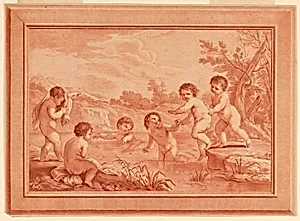
Boys at Play
Classification
Department
Smithsonian Collection
Museum
Smithsonian American Art Museum
Credit
Bequest of George Campbell Cooper
Accession Number
1896-3-320
Rights
Public Domain
About this artwork
Research in Progress
Art Historical Context
Francesco Bartolozzi, an Italian engraver who spent much of his career in England, created *Boys at Play* during his productive years in London between 1775 and 1800. Known for his mastery of stipple engraving and reproductive prints, Bartolozzi often translated paintings by leading artists of the day into widely circulated prints. This work, classified simply as a print, reflects the vibrant printmaking culture of late eighteenth-century Britain, where such images brought scenes of everyday life and classical themes to a growing middle-class audience. As a print in the Smithsonian American Art Museum’s collection, *Boys at Play* offers a glimpse into the period’s interest in childhood and leisure. Bartolozzi’s technical skill allowed him to capture delicate textures and lively expressions, qualities that made his works highly sought after by collectors. The title suggests a lighthearted genre scene, typical of the era’s fascination with innocent, playful moments rendered with neoclassical grace. Acquired through the bequest of George Campbell Cooper, the print remains an example of Bartolozzi’s lasting influence on Anglo-Italian artistic exchange. Though research on this specific piece continues, it stands as a testament to the enduring appeal of reproductive prints in sharing art across social and national boundaries.