
Bracelet
Classification
jewelry
Department
Smithsonian Collection
Museum
Smithsonian American Art Museum
Credit
Bequest of Raizel Halpin and Dora Jane Janson, in honor of their great friendship and shared love of antique jewelry
Accession Number
2003-20-1
Rights
Public Domain
About this artwork
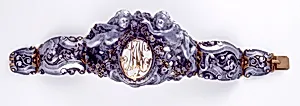
Cuff-type bracelet of five hinged, aluminum sections embellished with brass and gold; the large central section showing two winged cherubs amidst ribbons, garlands and scrollwork, floating above an oval cartouche containing an open-work gold panel with the scrolling, intertwined initials 'MJ' or 'MJC'; the central section flanked by smaller sections of strapwork and scrolls, the section on the left showing a bird and snake, the one on the right with a lizard and snake; the two outer sections of ...
Art Historical Context
Crafted around 1860 by French jeweler Honoré Séverin Bourdoncle1823–1893), this cuff-style bracelet exemplifies mid-19th-century innovation in jewelry design. Composed of five hinged aluminum sections adorned with brass and gold, it aluminum's rising popularity as a lightweight, affordable alternative to silver or gold— a material newly viable after industrial advances made it extractable and malleable. The gold hinges, catch, and intricate embellishments add a luxurious contrast, blending practicality with opulence typical of Second Empire France. At its heart, the large central panel features two winged cherubs frolicking amid ribbons, garlands, and scrollwork, hovering above an oval cartouche with an openwork gold panel bearing the intertwined initials "MJ" or "MJC." This personalization suggests a romantic or commemorative gift, perhaps a love token. Flanking sections depict symbolic motifs—a bird and snake on one side, a lizard and snake on the other—evoking themes of vigilance, temptation, or eternal bonds, framed by elaborate strapwork and scrolls in a neo-Rococo style that revived 18th-century exuberance. Now in the Smithsonian American Art Museum through the bequest of Raizel Halpin and Dora Jane Janson, who cherished antique jewelry, this piece reflects the era's fusion of sentimentality and technical prowess, inviting us to ponder the stories etched in its delicate forms.