
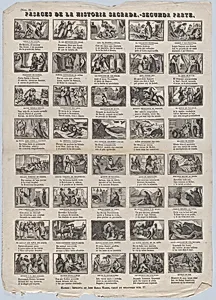
Broadside with 48 scenes illustrating passages of holy scripture (Part II)
ca. 1860–70
Medium
Wood engraving
Dimensions
Sheet: 17 5/16 × 12 3/16 in. (44 × 31 cm)
Classification
Prints
Department
Drawings and Prints
Museum
Metropolitan Museum of Art, New York, NY
Credit
Max G. Wildnauer Fund, 1978
Accession Number
1978.643.59(4)
Rights
Public Domain
Tags
Art Historical Context
This expansive wood engraving by Spanish artist José María Marés created around 1860–70, is Part II of a broadside 48 intricate vignettes illustrating key passages from holy scripture. Produced during a time when religious prints flourished in Catholic Europe, such broadsides served as affordable devotional aids for homes and churches, blending education with piety. Marés masterfully captured biblical narratives—depicting men, women, lions, and figures in prayer—within a compact 17 5/16 × 12 3/16 in. sheet, making complex stories accessible to the faithful. Wood engraving, the medium here, marked a technical pinnacle of 19th-century printmaking. Unlike earlier woodcuts, it used end-grain wood blocks for finer lines and tonal effects, rivaling metal engravings in detail. This allowed Marés to crowd vivid scenes into a single composition, evoking the dramatic intensity of religious life. Housed in the Metropolitan Museum of Art's Drawings and Prints department (acquired via the Max G. Wildnauer Fund in 1978), it exemplifies how prints democratized art, bridging elite workshops with everyday worshippers. Today, this work highlights the cultural role of visual storytelling in sustaining faith amid industrialization, offering visitors a window into Victorian-era spirituality through its lively, tag-rich tableau of scripture.
About the Artist
José María Marés · 1850–1870
José María Marés was a Spanish printer, publisher, and broadside producer active in Madrid from approximately 1850 to 1870. Operating first from addresses on the Calle de Relatores and later from the Plazuela de la Cebada under the imprint Imprenta de Marés y Compañía, he ran one of the more prolific popular-print establishments in mid-nineteenth-century Madrid. His presses produced illustrated br...