
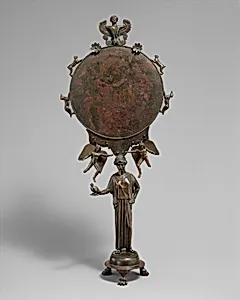
Bronze mirror with a support in the form of a draped woman
Unknown Artist
mid-5th century BCE
Medium
Bronze
Dimensions
15 15/16 in., 2 lb. (40.4 cm, 0.9 kg)
Classification
Bronzes
Culture & Period
Greek, Argive · Classical
Department
Greek and Roman Art
Museum
Metropolitan Museum of Art, New York, NY
Credit
Bequest of Walter C. Baker, 1971
Accession Number
1972.118.78
Rights
Public Domain
Tags
Art Historical Context
This exquisite bronze mirror, crafted in mid-5th century BCEive Greece during the Classical period, exemplifies fusion of everyday utility and artistic mastery in ancient Hellenic culture. Standing at nearly 16 inches tall and weighing just 2 pounds, it features a highly polished reflective surface supported by the graceful figure of a draped woman, evoking an idealized female form or mythological attendant. Delicate motifs of birds, women, and dogs adorn the design, suggesting scenes of daily life, myth, or symbolic harmony between humans and nature—common themes in Greek art that celebrated beauty and the divine. Bronze mirrors like this were prized possessions, often used in grooming rituals and as offerings in sanctuaries, highlighting women's roles in household and religious life. The Argive workshop's expertise shines through in the lost-wax casting technique, allowing intricate detailing in the drapery's soft folds and the lively animal figures, which capture motion and realism hallmarks of Classical sculpture. Its survival underscores the technical prowess of Greek bronzesmiths, many of which were melted down in antiquity, making this rare survivor a window into a golden age of innovation. Bequeathed to the Metropolitan Museum of Art in 1971 by Walter C. Baker, this mirror invites us to ponder the ancients' blend of function and finesse, where even a personal object became a work of timeless elegance.