
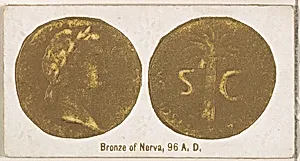
Bronze of Nerva, 96 A.D., from the Ancient Coins series (N180) issued by Wm. S. Kimball & Co.
Medium
Commercial color lithograph
Dimensions
Sheet: 1 1/2 × 2 5/8 in. (3.8 × 6.7 cm)
Classification
Prints|Ephemera
Department
Drawings and Prints
Museum
Metropolitan Museum of Art, New York, NY
Credit
The Jefferson R. Burdick Collection, Gift of Jefferson R. Burdick
Accession Number
63.350.216.180.10
Rights
Public Domain
Tags
Art Historical Context
This charming chromolithograph, titled *Bronze of Nerva, 96 A.D.*, captures the portrait from an ancient Roman bronze coin during the brief reign of Emperor Nervar. 96–98 CE). As the first of Rome's "Five Good Emper," Nerva's rule marked a transition from the turmoil of Domitian's era to a period of stability and reform. Produced in 1888 by William S Kimball & Company as part of their "Ancient Coins series (N)," this tiny print (just 1 1/2 × 2 5/8 inches) reflects the 19th-century American fascination with classical antiquity, often showcased through collectible ephemera. The medium—commercial color lithography—highlights the era's printing innovations, allowing vibrant, affordable reproductions of historical artifacts for mass audiences. Kimball & Co., a Rochester-based firm, distributed these cards alongside consumer products, blending education with marketing in the Gilded Age tradition of trade cards. The precise detailing of the coin's obverse, with Nerva's laureate bust, evokes the emperor's dignified legacy while demonstrating lithographic skill in miniaturizing ancient grandeur. Today, housed in the Metropolitan Museum of Art's Jefferson R. Burdick Collection, this piece exemplifies ephemera as cultural artifacts—disposable yet enduring windows into Victorian collecting habits and the democratization of history through prints. A delightful nod to how everyday objects preserved the past!
About the Artist
William S. Kimball & Company · 1850–1950
**William S. Kimball & Company**, a pioneering American tobacco manufacturer, was established in 1846 in Rochester, New York, by William S. Kimball and James C. Hart. The firm quickly grew into one of the city's largest employers, particularly of women, producing popular brands like Peerless chewing tobacco, Rigatta and Fireside smoking tobacco, and Vanity Fair cigarettes. Under Kimball's leadersh...