
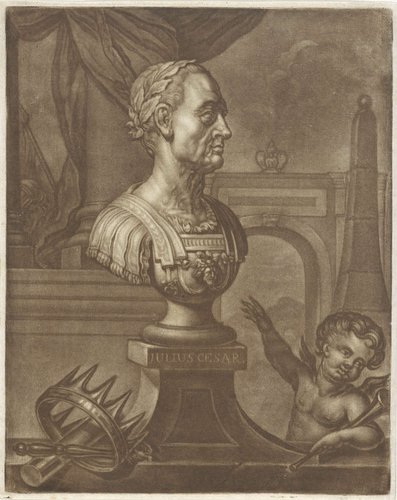
Buste van Julius Caesar
1740 - 1774
Medium
paper
Dimensions
242; 190
Rights
Public Domain
About this artwork
collector's mark: Lugt 2228
Art Historical Context
This delicate paper work, created by Dutch artist Pieter Anthony Wakkerdak sometime between 1740 and 1774, presents a bust-length portrait of Julius Caesar. Rendered on a modest sheet measuring 242 by 190 millimeters, the drawing captures the Roman leader’s distinctive features—his laurel wreath, strong profile, and authoritative gaze—in a format that suggests either a preparatory study or a finished collector’s piece. The presence of the Lugt 2228 collector’s mark indicates it once belonged to a distinguished European collection, underscoring its value to later connoisseurs. Wakkerdak worked during the height of the Enlightenment, when renewed interest in classical antiquity inspired artists across Europe to revisit Roman subjects. By choosing paper as his support, he embraced a medium prized for its immediacy and portability, allowing for the fluid lines and subtle tonal modeling often seen in 18th-century portrait drawings. The resulting image bridges ancient history and contemporary taste, inviting viewers to consider how Caesar’s image continued to symbolize power and leadership long after the Roman Republic. Today the sheet offers a quiet window into both artistic practice and collecting culture of the period. Its restrained scale encourages intimate viewing, while the classical subject matter reflects the era’s fascination with republican ideals and heroic biography.
About the Artist
Pieter Anthony Wakkerdak · 1729–1774
Pieter Anthony Wakkerdak (1729–1774) was a Dutch printmaker, painter, draughtsman, publisher, and poet whose brief but productive career exemplified the versatility expected of 18th-century Dutch artists. Born on June 14, 1729, in Rotterdam and dying on November 28, 1774, in Delft at just forty-five years old, Wakkerdak worked across multiple media including mezzotint (black art), oil painting, en...