
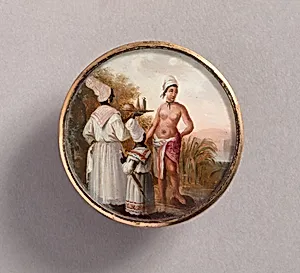
Button
late 18th century
Classification
costume & accessories
Department
Smithsonian Collection
Museum
Smithsonian American Art Museum
Credit
Gift of R. Keith Kane from the Estate of Mrs. Robert B. Noyes
Accession Number
1949-94-16
Rights
Public Domain
About this artwork
Research in Progress
Art Historical Context
Agostino Brunias (ca. 1730–1796), an Italian painter known for his vibrant depictions of Caribbean life during the late 18th century, created this intriguing artifact titled *Button*. Active in the West Indies after emigrating from Europe, Brunias captured the diverse cultures, free people of color, and societies of islands like Dominica and St. Vincent often under the patronage of British officials. His works blend Rococo elegance with ethnographic detail, offering rare glimpses into a multicultural colonial world. Classified as a costume and accessory in the Smithsonian American Art Museum's collection, this late 18th-century button exemplifies the exquisite craftsmanship of personal adornments from the era. Fashion then emphasized decorative elements like buttons on garments, which could signify status, trade connections, or cultural exchange across the Atlantic. Though its exact medium awaits further research—highlighted by the museum's "Research in Progress" note—this piece likely reflects Brunias's eye for ornamentation, possibly featuring painted motifs or intricate designs tied to his island portraits. Donated through the Estate of Mrs. Robert B. Noyes via R. Keith Kane, the button invites us to ponder everyday luxuries of the time. As curators delve deeper, it promises to reveal more about 18th-century transatlantic style and Brunias's versatile legacy. (198 words)