
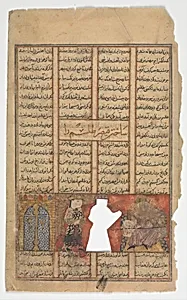
"Caesar Makes a Talisman", Folio from a Shahnama (Book of Kings)
ca. 1330–40
Medium
Ink, opaque watercolor, and gold on paper
Dimensions
H. 1 5/8 in. (4.2 cm) W. 4 5/16 in. (11 cm)
Classification
Codices
Department
Islamic Art
Museum
Metropolitan Museum of Art, New York, NY
Credit
Purchase, Gifts in memory of Richard S. Perkins, and funds from various donors, 2003
Accession Number
2003.330.4
Rights
Public Domain
Tags
Art Historical Context
This exquisite folio, titled *"Caesar Makes a Tal"*, comes from a *Shahnama* (Book of Kings), the monumental Persian epic poem composed by Abu'l Qasim Firda around 1010 CE. Dating to circa 1330–40, it captures a legendary scene from the poem where Caesar—likely representing the Byzantine emperor in the narrative—crafts a protective talisman, blending myth, history, and magic in Iran's rich storytelling tradition. As part of an illuminated manuscript in the Islamic Art collection at the Metropolitan Museum of Art, this tiny gem (just 4.2 x 11 cm) showcases the artistry of anonymous Persian painters from a royal workshop, possibly in Tabriz or Baghdad during the Ilkhanid era. Rendered in ink, opaque watercolor, and gold on paper, the miniature exemplifies the refined techniques of Persian illumination. Fine lines delineate figures and architecture, while vibrant gouache colors and shimmering gold heighten the drama, creating a luminous world within a single page. Such codices were prized treasures, often commissioned for rulers, merging poetry with visual splendor to preserve epic tales of kings, heroes, and moral lessons. Culturally, the *Shahnama* symbolizes Persian identity, influencing art and literature for centuries. This folio invites visitors to marvel at how 14th-century artisans brought Firdausi's verses to life, offering a window into a vibrant Islamic heritage where history and fantasy intertwined.
About the Artist
Abu'l Qasim Firdausi · 935–1020
Abu'l Qasim Firdausi, born around 940 in the village of Paj near Tus in Khorasan (modern-day Iran), emerged from a family of landed gentry known as dehqans, who preserved ancient Iranian oral traditions amid the cultural renaissance of the Samanid Empire. Little is documented about his early life or formal training, though he likely received a basic education including Arabic literacy, immersing h...