
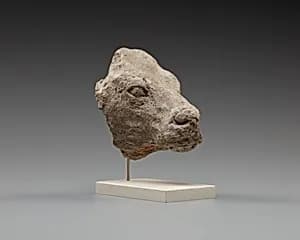
Calf's head
Unknown Artist
ca. 1981–1640 B.C.
Medium
Clay (unfired)
Dimensions
L. 5.8 × W. 4 × H. 6.6 cm (2 5/16 × 1 9/16 × 2 5/8 in.)
Classification
Figurine, Calf's head
Period
Middle Kingdom
Department
Egyptian Art
Museum
Metropolitan Museum of Art, New York, NY
Credit
Rogers Fund, 1932
Accession Number
32.1.138
Rights
Public Domain
Tags
Art Historical Context
Behold the delicate "Calf's Head," a small yet evocative artifact from ancient Egypt's Middle Kingdom (. 1981–1640 B.C.), specifically Dynasties 12–13. Crafted by an unknown artist, thisired clay model captures the features of a young calf—wide eyes, soft muzzle, and perked ears—in exquisite detail despite its modest size of just 6.6 cm high. Discovered and acquired through the Rogers Fund in 1932, it now resides in the Metropolitan Museum Art's Egyptian Art collection. The use of unfired clay, a fragile medium prone to decay, highlights its likely role as a votive offering or tomb model rather than a durable sculpture. During the Middle Kingdom, a golden age of artistic refinement and political stability following Egypt's reunification, such animal figurines were common in burials. They symbolized fertility, nourishment, and divine protection, invoking deities associated with cattle like Hathor, ensuring sustenance for the deceased in the afterlife. This tiny masterpiece invites us to ponder the Egyptians' profound connection to the animal world, where everyday creatures embodied eternal cycles of life and renewal. Its survival over millennia speaks to the reverence for these intimate, handmade treasures.